

Key points
Efforts by Germany and the European Union to advance climate mitigation internationally are under pressure. Domestic political priorities have shifted, international tensions and conflicts have increased, conventional approaches to international climate cooperation have reached a roadblock. At the same time, renewable energy is more cost-efficient than ever, and Germany’s and the EU’s dependence on fossil fuel imports has underscored the economic and security benefits of decarbonisation. This paper starts out be reviewing the economic case that pursuing ambitious climate mitigation globally is in the material interest of Germany and the EU.
A strategic portfolio of policies is needed respond to the challenges to effective climate cooperation. We discuss selected elements of such a portfolio: There is a need for instruments and policies to support other countries financially to boost their mitigation efforts to enable international flexibility in attaining EU climate goals, shield domestic mitigation efforts against external pressure, and secure the resources required for domestic mitigation. The paper highlights as examples the Just Energy Transition Partnerships, the EU’s Carbon Border Adjustment Mechanism, and the novel proposal for Jurisdictional Reward Funds.
Since the current outlook for advancing global mitigation under the multilateral UNFCCC umbrella is limited, it is also critical to strategically consider the appropriate formats for climate diplomacy. While the annual COPs retain an important function as the metaphorical big tent for global cooperation, bi- and plurilateral forms of cooperation have gained more traction in recent years. They, however, also do not necessarily deliver the promises of policy that on paper is effective, as recent examples with the Climate Club or the Just Energy Transition Partnerships have shown. More effective coordination within Germany and the EU remains a prerequisite.
- Efforts to advance climate mitigation internationally are under severe pressure. Domestic political priorities have shifted, international tensions have increased, and conventional approaches to climate cooperation have reached a roadblock. Germany and European Union are faced with the challenge of advancing global climate action in an increasingly uncooperative world.
- At the same time, renewable energy is more cost-efficient than ever, and Germany’s and the EU’s dependence on fossil fuel imports has underscored the economic and security benefits of decarbonisation. Ambitious international climate policy is in the material interest of Germany and the EU – even and especially under the new political and economic circumstances.
- There is a range of established as well as novel policy options for strategically acting on this interest. They include supporting other countries’ decarbonisation financially, altering incentive structures while shielding domestic mitigation efforts against undue external pressure, and managing mitigation technology supply chain risks.
- There are also a range of potential fora and processes for implementing those policies. The annual COPs are in need of reform but retain an important function for upholding multilateral cooperation. Plurilateral initiatives and bilateral partnerships can advance mitigation within tighter groups of like-minded partners but require clear objectives and prioritisation. Internal coordination within the German government and the EU Commission is critical for effective international outreach.
Summary
Efforts by Germany and the European Union to advance climate mitigation internationally are under pressure. Domestic political priorities have shifted, international tensions and conflicts have increased, conventional approaches to international climate cooperation have reached a roadblock. At the same time, renewable energy is more cost-efficient than ever, and Germany’s and the EU’s dependence on fossil fuel imports has underscored the economic and security benefits of decarbonisation. This paper starts out be reviewing the economic case that pursuing ambitious climate mitigation globally is in the material interest of Germany and the EU.
A strategic portfolio of policies is needed respond to the challenges to effective climate cooperation. We discuss selected elements of such a portfolio: There is a need for instruments and policies to support other countries financially to boost their mitigation efforts to enable international flexibility in attaining EU climate goals, shield domestic mitigation efforts against external pressure, and secure the resources required for domestic mitigation. The paper highlights as examples the Just Energy Transition Partnerships, the EU’s Carbon Border Adjustment Mechanism, and the novel proposal for Jurisdictional Reward Funds, which are multilateral, rules-based and performance-based payments for governments that can scale up international climate finance.
Since the current outlook for advancing global mitigation under the multilateral UNFCCC umbrella is limited, it is also critical to strategically consider the appropriate formats for climate diplomacy. While the annual COPs retain an important function as the metaphorical big tent for global cooperation, bi- and plurilateral forms of cooperation have gained more traction in recent years. They, however, also do not necessarily deliver the promises of policy that on paper is effective, as recent examples with the Climate Club or the Just Energy Transition Partnerships have shown. More effective coordination within Germany and the EU remains a prerequisite.
1. Introduction
In late 2021, there appeared to be a window of opportunity for advancing international climate cooperation. The United States had rejoined the Paris Agreement. The European Union had passed the European Climate Law, spurring on the implementation of its Green Deal. Germany had put climate action high on its agenda. China had announced its first net-zero carbon target just the year prior.
Some five years later, international climate politics unfold in a fundamentally shifted context. Climate cooperation is deeply implicated in security and economic concerns. Trust between the Global North and the Global South has eroded in the wake of conflicts in Ukraine and the Middle East and cuts to foreign aid budgets. Trade tensions and the strategic use of supply chains have driven a resurgence of protectionist measures and deepened geoeconomic rivalry. The closure of the street of Hormuz has again exposed the vulnerability of the global economy and the European Union to fossil fuel supply shocks. Global fragmentation on the one hand is set against rapid deployment of renewable energy and the rise of clean technology value chains on the other. The United States’ retreat from, and adversarial posture towards, international climate cooperation under the second Trump administration aggravates these challenges. Meanwhile, China’s emergence as a leading exporter of clean technologies could mean that its long-term interests in climate and energy politics align more closely with those of Europe than within the transatlantic partnership. Internally, the European Union faces difficulties in aligning its member states’ positions on security (e.g., regarding Ukraine) and climate policy issues.
This shifted international context requires a revised assessment of the strategic outlook on international climate cooperation for Germany and the European Union.
The need for a strategic realignment is compounded by the state of affairs in international climate cooperation writ large. The operationalisation of the Paris Agreement is now essentially complete. The COP 29 climate summit in Baku (2024) saw the finalisation of work regarding the trading of carbon credits under Art. 6.2 and 6.4 of the Paris agreement, completing the Paris rulebook. The third round of nationally determined contributions (NDCs), which were due in 2025, marks the first time that these commitments are built on the full Paris framework. The significant gap between the global aggregated NDCs and global mitigation pathways consistent with the 1.5 °C/2 °C target reflects the limits of the ratchet-up mechanism’s ability to nudge parties to adequately increase their national ambition. Both the UN Secretary-General and, implicitly, also the most recent UN climate summit Belém (COP 30) concede that exceeding the 1.5 °C goal is essentially inevitable (see also Geden (2016)). The EU has been forced into a more defensive posture at recent climate summits and has not managed to assemble coalitions for more ambitious outcomes (Könneke and Adolphsen, 2026).
Domestically, the German government has moved towards prioritising security and competitiveness, echoing developments throughout Europe. At the same time, limited fiscal space has put growing pressure on both domestic climate policy and international commitments, with cuts to the foreign aid budget likely to translate into reductions in Germany’s international climate finance, although Germany has become the largest individual contributor following the US funding cuts.
The European Union recently agreed an ambitious 90 percent net emissions reductions target by 2040 (relative to 1990). This target envisages that five percent reduction can be achieved using high-quality international emissions credits. This increases the importance an institutional structure that enables production and acquisition of credits via high-integrity international flexibility mechanisms for the EU. However, at the level of individual policy instruments, the delayed introduction of the ETS 2, vehicle carbon-intensity standards, and the Carbon Border Adjustment Mechanism (CBAM) highlight the increasing contestation of climate policy ambition within the EU, given concerns about competitiveness. These internal debates over climate policy fundamentals, paired with the delayed decision on the 2040 target, which also delayed the EU’s NDC submission, hamper its ability for proactive diplomatic outreach and risk damaging its reputation as a global climate policy champion in the eyes of external partners.
Against this backdrop, this paper tackles three key questions: (1) Why should Germany and the EU continue pursuing an ambitious international climate policy, even under new and more challenging conditions? (2) How can the EU and Germany enhance climate ambition internationally under new and more challenging conditions? (3) How can they protect the stringency of their domestic climate policies in light of current global trends and challenges?
To answer these questions, we proceed in three steps. First, given the increased focus in political debates on national self-interest in challenging international security and economic contexts, we review the case for a self-interest rationale for Germany and the EU to pursue ambitious international climate policy (section 2). We then tackle questions 2 and 3 at the analytically distinct levels of policy and process. Regarding policy, we discuss selected elements of a strategic portfolio of policies aligning with Germany’s and the EU’s interests (section 3). Regarding process, we consider the importance of and options for organising diplomatic efforts to deploy and implement international climate policy (section 4).
2. German and EU international climate policy from a self-interest perspective
In view of increasing global tensions, economic stagnation, and shifting domestic priorities, there are growing calls for Germany’s and the EU’s international climate policy to be more closely aligned with its self-interest. These calls offer the opportunity to take a step back and reflect. What are the key reasons for Germany and the EU to pursue an ambitious climate policy in the first place – both internationally and domestically? And which international challenges need to be considered in designing its (domestic and international) policy portfolio?
We identify key reasons why it would be beneficial purely from a perspective of self-interest for Germany and the EU to commit diplomatic and financial resources to pursuing ambitious international climate action: the gradual reduction of domestic climate damages (measured by the national social cost of carbon, section 2.1) as well as additional benefits in other policy areas (section 2.2). While we consider material self-interest as the politically (cross-partisan) most stable basis for international climate action, we also acknowledge the well-established normative case for climate action (section 2.3). While none of these arguments are conceptually new per se, co-benefits related to trade and geopolitical aspects of global emission reductions have hardly received sufficient political attention and have only recently been quantified for Germany and the EU in academic research. In the current global context, it is worth emphasising that climate change is not a soft issue but has important economic and foreign-policy dimensions. We focus our analysis on climate mitigation, recognising that a holistic approach will also have to take into account mitigation, adaptation, as well as loss and damage.
Box 1: Assessing the Social Costs of Carbon
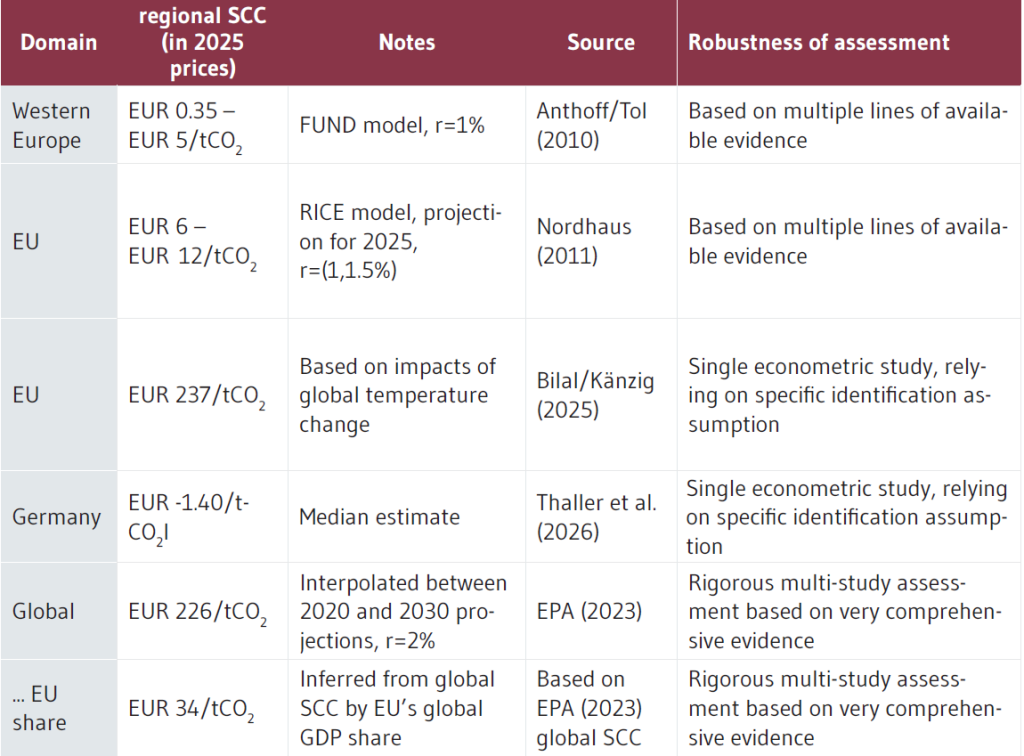
Early estimates by Anthoff and Tol (2010) for Western Europe as a region using the so-called FUND Integrated Assessment Model (IAM) and Nordhaus (2011) for the EU as a regional bloc using the RICE model employed conservative climate models compared to newer standards in IAMs. Updating the damage function of the DICE model, Hänsel (2020) find notably higher SCC than in the baseline specification by Nordhaus (2018).
Recently, econometric models using climate-GDP regressions have been used to infer climate damages and social cost of carbon. Thaller et al. (2026) find negative nSCC for Germany. By building on a regression of GDP on local climate change variables, their analysis is likely to underestimate the nSCC. Comprehensive nSCC estimates should reflect the knock-on costs of climate change impacts in other regions with consequences for Germany and the EU. Trade effects significantly increase the exposure of open economies (Hambel et al., 2021), while migration and conflict imply that adverse climate change impacts on other world regions can directly affect domestic interests (see below). Bilal and Känzig (2025) partially resolve this by simulating the effect of global temperature change and extreme weather events, yielding one to two orders of magnitude larger nSCC values at the expense of largely departing from the methodological approach in the established literature. Notably, anyeconometric climate-GDP approach is subject to severe methodological limitations (e.g., very limited number of observations, see Lemoine et al. (forthcoming) and Burgess and Curtin (2026)) that questions its suitability for SCC calculations.
By building on bottom-up sectoral damage functions, which do not rely on the GDP-temperature regression, the American Environmental Protection Agency (EPA) (2023) provides the most comprehensive SCC estimate, though they similarly abstract from trade-mediated and macroeconomic growth channels. Since the EPA only computes global SCC, the nSCC can be roughly approximated following the GDP-proportionality assumption in Nordhaus (2015). With the EU accounting for around 15 % of global GDP, this implies EUR 34 of the global SCC of EUR 226 accrue to the EU. This approach is consistent with previous work (Edenhofer et al., 2025) and will thus be employed in section 2.2. There, we also adjust these nSCC values for carbon leakage which needs to be taken into account when considering the actual expected emissions reduction effects from international policies.
2.1 Economic benefits: National social cost of carbon
From an economic perspective, the simple reason to pursue international climate policy out of material self-interest is that, regardless of where in the world greenhouse-gas (GHG) emissions are abated, every ton gradually reduces future climate damage in Germany and the European Union.
Economists use the concept of the regional or national social cost of carbon (nSCC) to operationalise this idea. It is important to note that while the nSCC is an economic concept lending itself to clear – albeit disputed (e.g., Aldy et al., 2021; Barrage and Nordhaus, 2024; Burgess and Curtin, 2026; Kaufman et al., 2020; Stern et al., 2022, see also below) – analytical expression and quantification, it essentially explicates a basic intuition: The economically rational willingness to pay for climate change mitigation due to material self-interest. The nSCC allows calculating the (varying) regional or national valuation of GHG emissions reductions by different individuals and groups and enables making transparent the different assumptions about the many uncertain parameters in climate policymaking that often underpin disagreement over adequate levels of climate policy ambition. Thus, nSCC estimates vary not only across studies (see below) but also – usually implicitly – across population groups and individuals, including policymakers. The key point is that these preferences – the valuation of emission reductions – matter for domestic and international climate policymaking as they determine which level of international (and national) climate change mitigation ambition is perceived to be in the national interest. In the following, we refer to the concept of nSCC to revisit the economic rationale for ambitious international climate action. We will take leakage effects from policies into account in our analysis in Section 2.2. Note also that we do not explore the application of nSCC for cost-benefit analysis of domestic climate policies.
The overarching point is that independent of the precise magnitude of nSCC assessments, Germany and the EU have a tangible economic interest in providing financial support for greenhouse gas emission reductions anywhere in the world so long as they are cheaper than the resulting domestic benefits. Hence, the self-interested, non-cooperative perspective implies a gradual climate policy of global emission reductions that is between the two extremes of doing no climate policy at all and implementing globally optimal climate policy under full cooperation. Other regions will face a symmetric incentive, but since the pure self-interest perspective ignores benefits of emission reductions for others, the aggregate global effort from every country individually optimizing their policy ambition in line with their nSCC would still fall short of what is usually specified as a global welfare optimum.
The unilateral incentive for supporting mitigation at the level of the nSCC is independent of the global free-rider problem in mitigation. When cooperation mechanisms can partly or fully reduce free riding incentives via adequate institutional design, the unilateral incentives for supporting mitigation can increase and converge – under full cooperation – to the global SCC. Hence, the EUR 34/tCO2 (EU-SCC) assumed here constitutes a lower bound of national SCC that is based on European self-interest.
2.2 Additional benefits
In addition to preventing climate change damages, reducing GHG emissions globally yields synergies with further material self-interest objectives of Germany and the EU. We highlight four additional benefits of global emission reductions: (1) positive terms-of-trade effects in oil and gas trade, (2) reduced income for adversarial oil- and gas-exporting countries, (3) enhanced human security and associated effects, and (4) broader synergies in foreign policymaking. As these benefits are for the most part (1-3) independent of where the emission reductions are realised, they provide additional incentives for the EU and Germany to engage in fostering emission reductions (and particularly gas and oil demand reductions) in other countries.
Terms-of-trade effect on oil and gas markets: Germany and the EU are net importers of oil and gas. A reduction in global demand for these energy sources by pricing them – regardless of where in the world – lowers their global market prices. The EU as a major importer of oil and gas benefits from this effect via improved terms of trade, i.e., buying fossil fuels at lower prices.
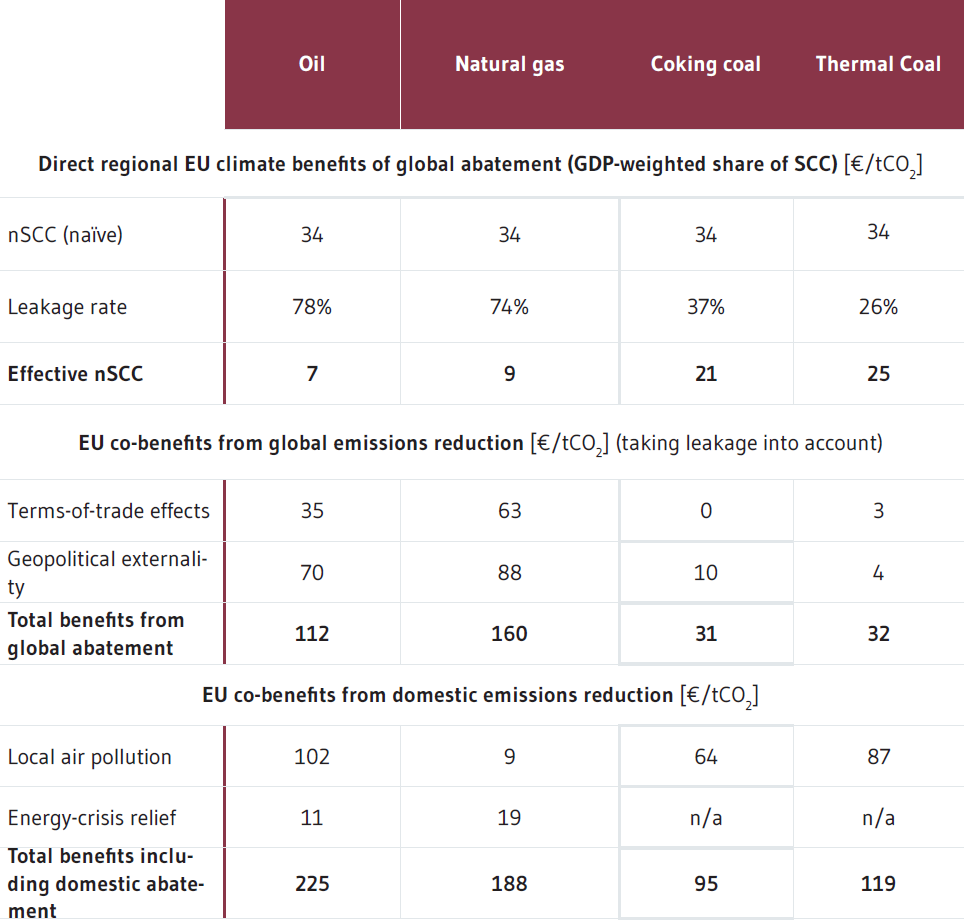
Edenhofer et al. (2025) estimate terms-of-trade benefits per globally abated ton of CO2 for different fuels. The effect depends on the EU’s share of global fuel consumption as well as global elasticities of fuel supply and demand. Taking global supply and demand adjustments into account, the effect amounts to EUR 20-40/CO2 with EUR 35/tCO2 as central estimate for oil and is almost twice as large for natural gas with a central estimate of EUR 63/tCO2.1The number for natural gas has been taken from the interactive spreadsheet referenced in Edenhofer et al. (2025) instead of the paper directly. This reflects two factors: the highly inelastic supply and demand for natural gas, and the higher price of natural gas per ton of CO2 relative to oil. Notably, these terms-of-trade effects occur regardless of whether fossil demand is reduced domestically by the EU or abroad since they materialise via lower world market prices. The terms-of-trade effects for thermal and coking coal, by contrast, are substantially smaller because of a lower import share of the EU, higher elasticities and lower fuel prices. This suggests a focus on policies reducing both domestic and international demand for oil and gas, which we discuss in section 3.
Reduced revenue for adverse oil- and gas-exporters: A second effect of reduced global gas and oil market prices is a reduction of government revenues of oil- and gas-exporting countries. Some of these countries, like Russia, may have adverse interests to those of Germany and the EU. As fossil fuel export revenues help financing Russia’s war in Ukraine with substantial costs for the EU, global demand (and, hence, price) reductions translate into a positive security dividend that constitutes an additional material and security interest on the part of the EU in global emissions reductions.
Beaufils et al. (2025) estimate this positive externality, taking into account global fossil fuel price elasticities with respect to global demand reductions, the share of fossil fuel rents appropriated by the countries where they are extracted, and the effect on the state budget and the corresponding global security costs. With regard to security concerns vis-à-vis Russia, they estimate that on average each euro spent on oil imports by the EU generates 32 cents in indirect geopolitical costs for the EU by increasing global oil prices and expanding the Russian state budget and thus fiscal leeway for military expenses. This effect does not depend on where the EU buys its oil, since it works through the global oil market. Expressing these costs relative to the carbon content of the respective fuels means that the geopolitical externality alone justifies an EU import tax on oil (regardless of the source) of about EUR 70 per ton of CO2 and EUR 80 per ton of CO2 on gas (Beaufils et al., 2025, adjusted to 2025 prices). Given the uncertainties about the parameters that are needed to estimate this figure, it is conceivable that the actual magnitude of the geopolitical externality of oil consumption in the EU could be more than ten times larger than the central estimate. As in the case of terms-of-trade effects, the geopolitical dividend accrues from both domestic and global demand reduction via their effect on world market prices. Hence, even as most fossil fuel imports from Russia have been banned, the EU can still reap gains from domestic or global demand reductions.
Importantly, this co-benefit is, just like the terms-of-trade effect, deeply linked to carbon-leakage effects that can result from fossil fuel demand reductions. As carbon leakage partly offsets a domestically avoided ton of CO2 by an increase in CO2 in other countries, it also reduces the benefits in terms of avoided climate damages from a domestic emission reduction. The nSCC of one ton reduced emissions in a specific country – after leakage – is therefore substantially lower than indicated in section 2.1.2Leakage rates are calculated using empirical assessments of approximated by dividing the price elasticities of global fuel demand and supply by the sum of the demand and supply elasticities (Beaufils et al. 2025, Edenhofer et al. 2025). The more elastic the global demand, the more readily the rest of the world compensates for demand reductions in specific regions and the higher the carbon leakage rate. The less elastic the supply, the less fossil-fuel producers reduce extraction in response to abatement by one country, resulting in higher leakage and falling fossil fuel prices such that global commodity markets still clear. Taken together, elastic demand and inelastic supply imply that terms-of-trade effects are high but effective nSCC effects are diminished by carbon leakage (Edenhofer et al. 2025). Table 2 gives an overview of the net domestic gains for the EU from globally abating a ton of CO2 by summing over leakage-adjusted nSCC and co-benefits from terms-of-trade and geopolitical effects. Takentogether, EU benefits from global demand reductions for fossil fuels range from EUR 32 (coal) to EUR 160 (gas) per ton of CO2.
Beyond considerations of international emissions reductions and climate policy, if CO2 is abated within the EU, additional co-benefits arise. A well-researched co-benefit of domestic fossil fuel abatement is the reduction of air pollution and associated health benefits. This co-benefit is highly localized and depends on the fuel and process from which emissions result. For domestic reductions of oil and coal consumption, the GDP-weighted EU-average air pollution benefits are in the range of EUR 60–100/tCO2, with natural gas as a lower outlier at EUR 9/tCO2 (Black et al., 2025).3Black et al. (2025) focus on mortality effects of air pollution, disregarding morbidity or other damages. Thus, their estimates should be treated as a conservative lower bound. For comparison, Hasse et al. (2026) calculate air-pollution costs for the residential use of natural gas in Germany of EUR 30/tCO2 based on air-pollution cost factors in the Methodological Convention of the Germany Environment Agency. Another co-benefit of reducing domestic fossil fuel consumption is reduced exposure to oil and gas price shocks. Based on relief spending during the 2022-energy price crisis, the cost of implicitly insuring citizens and domestic firms against price spikes is estimated to be EUR 11/tCO2 for oil and 19 EUR/tCO2 for natural gas (Beaufils et al. 2026b). Adding these co-benefits, abating a ton of CO2 domestically is worth up to EUR 225 to the EU in the case of oil, virtually exclusively driven by co-benefits and on par with the EPA-estimate of global SCC. By contrast, abating a ton of CO2 outside the EU is only worth up to EUR 112 (again in the case of oil) for the EU since local co-benefits at the point of abatement due not accrue to in the EU.
Human security and associated effects: Climate change impacts human security and wellbeing on several levels, threating livelihoods, aggravating conflicts and causing increased involuntary migration (von Uexkull and Buhaug, 2021).This makes it a moral imperative, enshrined into the principles of the UN climate convention (UN, 1992), for those who have responsibility and the resources to address these issues (see below). However, humanitarian crises, migratory pressures, and disruption to supply chains resulting from extreme weather events or other climate impacts (McLeman, 2018; Šedová et al., 2021) also have direct political consequences for Germany and the EU. It is, therefore, in the self-interest to consider the human-security dimension of climate change impact in foreign countries (Fahimi et al., 2025; Kahlen and Paiva, 2025; Kotchen and Martinez-Diaz, 2017).4Such effects are usually not included in nSCC assessments. Climate damages abroad also justify supporting adaptation efforts in the affected countries for the same reason. Moreover, while not the focus of this paper, strengthening the demand for renewable-energy technologies can provide economic opportunities for exporters of such technologies, including Germany (ibid.).
Synergies with other foreign policy priorities: Supporting climate mitigation internationally can benefit broader foreign policy goals and priorities for Germany and the EU (Fahimi et al., 2025; Flach et al., 2022; Kahlen and Paiva, 2025). For one thing, multilateralism remains a goal in itself for the German government (CDU et al., 2025). Continuing Germany’s efforts to advance multilateral climate cooperation (see section 4.1) is a requirement to credibly maintaining this goal. With regard to bilateral relations, there are potential benefits in the form of cross-cutting deals or cooperation. Germany and the EU can support countries in their transition to carbon neutrality with the tacit expectation of their support in other international policy areas such as security and trade in return. This rationale supports policies for supporting strategic partner countries in a range of ways, ideally – from a German and EU self-interest climate policy perspective – maximising mitigation (and, where these avoid adverse international spillovers, adaptation) outcomes.
2.3 The normative dimension
The material and political benefits of pursuing ambitious climate policy internationally are entirely notwithstanding the fundamental normative arguments for Germany and EU to act on climate change. The triple inequality of climate change – that those who suffer most tend to have contributed least to the problem and tend to be less well equipped to deal with the consequences – is not only at the core of climate change as a moral issue but reflected in the very principles of the UN climate convention (Barrett, 2013; Meyer and Roser, 2010; UN, 1992). The moral obligation derived from this include reducing climate damages in other and especially poorer countries via mitigation and adaptation – both because of concern for these countries’ citizens welfare and considerations of historical responsibility for climate change, as well as richer countries’ capacity to support poorer countries in their transition away from fossil fuels.
These considerations extend the material self-interest reasons discussed above. The support from voters, interest groups, and political parties for ambitious climate policy based on normative reasons, however, and therefore the persuasiveness of moral appeals, varies over time and across jurisdictions. The self-interest calculus outlined above, by contrast, can provides a more stable, widely supported national and European minimal baseline for climate policy stringency (even though, as discussed above, perceptions and assessments about the precise nSCC vary). In any case, national self-interest considerations can be expanded where the related normative rationales prevail in elected governments.
3. A strategic policy portfolio for enhancing international action and preserving domestic ambition
We have argued above that pursuing ambitious climate policy is in the economic self-interest of Germany and the EU. What, then, are the elements of a portfolio of policies that corresponds to the self-interest of the EU and Germany? We identify two general types of policy approaches for fostering international mitigation, and two for preserving domestic climate ambition. While these are not new by themselves, we believe they help cluster and shape policy strategies catering to different types of objectives. We then focus on several key elements of a strategic portfolio for Germany’s and the EU’s international climate policy and discuss their respective strengths and opportunities for further development.
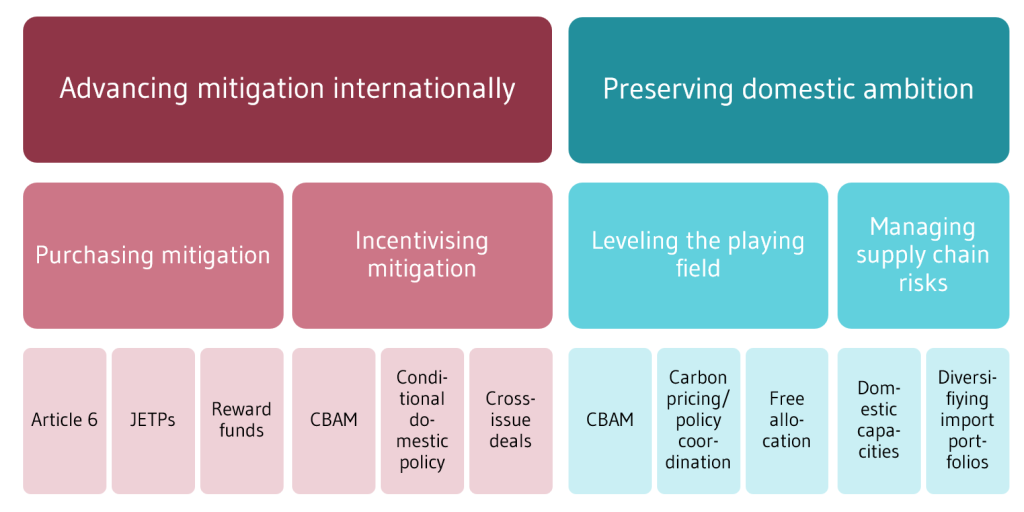
Advancing mitigation internationally: First, owing to the fact that it is irrelevant where in the world greenhouse gas emissions are reduced from a climate perspective (and for the non-climate oil and gas market effects discussed above), Germany and the EU can financially support other countries in reducing emissions so long as the marginal costs of reduction are lower than the German or European nSCC (3.1: Purchasing mitigation). Prominent examples for forums that facilitate this are arrangements under Article 6 of the Paris Agreement and the Just Energy Transition Partnerships (JETPs). Second, Germany and the EU can create incentives for other countries to adopt more stringent climate policies, without providing direct financial support (3.2: Incentivising mitigation). The EU’s CBAM, for example, creates an incentive for other countries to introduce carbon pricing instruments among other things (Beaufils et al., 2026b; Wolfram et al., 2025). A system of conditional carbon pricing announcements or international mitigation fund design might enable setting up a strategic climate club (Nordhaus, 2015).
Preserving domestic ambition: Germany and the EU can safeguard emission reductions at home against concerns over economic competitiveness by measures aimed at levelling the playing field (3.3). The most important policies are free allocation in the EU ETS and more recently the EU’s Carbon Border Adjustment Mechanism. Supply chain risks for clean energy technologies and critical raw materials can be managed (3.4) by building on careful analysis of market failures suggesting need for government intervention, and deployment of related measures. This includes strategic stockpiling and creating a comprehensive knowledge-base for firms to assess their exposure to supply interruptions so that they can devise effective diversification strategies.
These four approaches overlap and are not mutually exclusive. For example, the EU’s CBAM both creates incentives and aims at levelling the playing field. Establishing incentives for mitigation in other countries may be combined with financing parts of that effort. Managing clean tech supply chain risks is orthogonal to the three other categories as it is useful for Germany and the EU independent of the mitigation efforts of others.
3.1 Purchasing mitigation
The first option for Germany and the EU to advance global mitigation is to support others financially in their emission reduction efforts. This can be called purchasing mitigation, which means that decarbonisation measures are implemented in other countries, where they are more cost-efficient. Broadly speaking, this includes all forms of international mitigation finance.
The most straightforward policy in this category relates to multilateral rules for Article 6 international flexibilities under the Paris Agreement. Countries may support emissions reductions in other regions, and acknowledgement for related emissions reductions may be transferred via the Article 6 framework. A major remaining concern regarding Article 6 rules are additionality provisions, i.e. how to ensure emission reductions at a project level are additional relative to a counterfactual scenario. A growing body of empirical research shows that project-based offset mechanisms largely lack additionality (Calel et al., 2025; Probst et al., 2024; West et al., 2020). Even if better approaches to calculate baselines were developed in the future, project-based approaches risk to suffer from government crowding out, implying that receiving countries’ governments relax their mitigation ambitions when external funding finances otherwise non-profitable projects (Edenhofer et al., 2025).
Another pathway for purchasing emission reductions are the Just Energy Transition Partnerships (JETPs). They are a promising recent example of plurilateral cooperation (Fauzianto et al., 2025) which have fostered capacity building and strategic planning for energy transitions in target countries in recent years. While the four established JETPs (with South Africa, Indonesia, Senegal, and Vietnam) differ vastly in terms of political context and degree of implementation, they have encountered a number of critical challenges: Fragmentation of finance sources makes for unclear policy goals, high donor coordination requirements, and institutionally heavy governance architecture; alignment of donor and target country goals (e.g. focus on coal phase-out vs. broader transition and green development platform; (scale and type of mobilised finance tends to be misaligned with transition needs and target country demands (e.g. features loans rather than grants); and political economy constraints (e.g. vested coal interests) in the selected countries remain a challenge (Blos and Hirsch, 2024; Earsom, 2024; Jain and Bustami, 2025).
Enhancing the effectiveness of JETPs requires addressing these challenges. Scaling up the volume of funding requires donors to acknowledge the nSCC-related benefits from mitigation (see section 2). To the extent that there are concerns over the additionality of measures funded via JETPs (as with Article 6 purchases), a mutually acknowledged methodology for establishing it will be required – to which our discussion of JRFs speaks below. Addressing political economy barriers requires expanding the scope of planning and consultation and potential compensation, strategically targeting the ability of relevant veto players to inhibit transformations.
Overall, one important avenue for reforming JETPs is to develop them into country mitigation platforms, that is, building country-level institutional architectures that enable knowledge exchange via planning, coordinating, and implementing transitions from fossil fuel in country-specific development and explicitly address political economy challenges within and across countries.5We discuss the diplomatic challenges of setting up effective governance arrangements in section 4. Such permanent platforms – piloted also bilaterally by Germany in its P+ partnerships – might allow greater coherence and more ownership (Selvaraju et al., 2025).6Another more comprehensive format is the P+ – Climate and Development Partnership –approach established by the German Government as bilateral partnerships between Germany and selected developing and emerging countries. The aim of P+ is to jointly pursue climate mitigation and adaptation targets as well as overall sustainable development. Doing so, the focus is directed not only to help implement the 1.5 °C target set out in the Paris Agreement but at the same time integrate the SDGs (Sustainable Development Goals). The P+ partnerships are also considering policy-based financing approaches by linking financial support to political reforms (e.g. energy, climate and economic reforms). However, as a relatively new approach the P+ arrangements still need to show how impactful they in fact are. Importantly, they might form one key building block of an international institutional architecture enabling effective exchange of finance and emissions reductions when combined with Article 6 structures for acknowledging and transferring emissions reductions efforts. Importantly, they might be combined with a novel idea for establishing more credible additionality criteria – Jurisdictional Reward Funds – combining the strengths of the different approaches.
Jurisdictional Reward Funds (JRF) have recently been proposed as a way of ensuring the additionality of internationally purchased mitigation (Edenhofer et al., 2025). Conventional international climate finance largely focuses on project-based approaches (Clean Development Mechanism, Green Climate Fund, Global Environment Facility, Adaptation Fund, JETPs, etc.), which have intrinsic difficulties to ensure proper accounting for additionality due to strategic incentives to alter baselines, general equilibrium effects such as reshuffling of energy production, and government crowding out, lowering their overall effectiveness (Banerjee et al., 2026; Edenhofer et al., 2026). JRF switch the focus from financing small-scale projects to rewarding governments for large-scale reduction. They are a results-based payments (or policy-based financing) mechanism, which would reward recipient governments (not private investors) for having reduced emissions and incentivise exploiting least-cost mitigation options first. They are a results-based payments (or policy-based financing) mechanism, which would reward recipient governments (not private investors) for having reduced emissions and incentivise exploiting least-cost mitigation options first: As every ton of carbon reduced is rewarded at the same rate, countries with abatement options below that rate would, in principle, be incentivised to reduce emissions until marginal abatement costs equal the reward rate. If more funds become available, the reward rate can be increased to also incentivise more expensive abatement options. JRFs could be combined with Article-6 structures (for acknowledging the financing of mitigation) and with country platforms (for planning country transitions).
JRFs require defining baselines to determine the extent of the emission reductions. Using historic data (e.g., historic deforestation rates or oil demand) can, in the short run, approximate the true counterfactual development but lacks time-consistency: over time, incentives to adjust baselines to the ‘new historical norm’ grow and anticipation of such adjustments create perverse incentives to inflate emissions. As an alternative, universal baselines have been proposed that are uniform for all countries, except for a scaling factor that accounts for a country’s size in an incentive preserving way (see Kalkuhl and Stern (2025a) for more details). The universal baseline can then be optimised to achieve a maximum of emission reduction for a given budget: if the available purchase budget is small, the baseline should be very ambitious, implying that only few countries experience financial incentives. If the budget is large, the baseline should be set more generously to expand the number of countries who experience financial incentives; as a side-effect, windfall gains increase as more countries will find themselves already below the baseline. The optimal baseline approach balances both effects. As a result, Jurisdictional Reward Funds always create beneficial rents to receiving countries as well – which is the side-effect of a rules-based and time consistent incentive architecture.
Figure 2 illustrates the mechanism for a fund that rewards countries for reducing oil demand. The fund would announce the reward function, define variables and measurement and perform audits to verify outcomes. For deforestation-related funds, remote-sensed satellite data could be used; for fossil fuel taxes, methodologies for measuring total effective carbon rates, as developed by World Bank, IMF or OECD can be used (e.g. Agnolucci et al. (2024)).
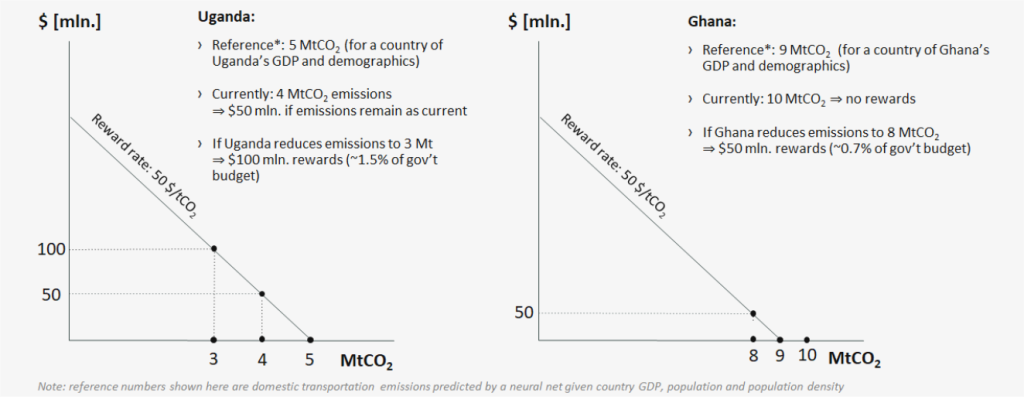
One existing example resembling this approach JRF are bilateral jurisdictional rewards funds such as Norway’s initiatives to reward the governments of Guinea and Ghana every year when deforestation rates were below the baseline rate (Regjeringen, 2023, 2009). The reward amount was proportional to the amount of forest saved, implying a fixed reward per hectare saved (or, alternatively, per ton of CO2 avoided from deforestation, see Roopsind et al., 2019). The Tropical Forest Forever Facility (TFFF) add proposal launched at COP 30 aims to broaden this approach from bilateral to multilateral level (TFFF 2026). Countries can contribute to the fund which rewards all countries hosting tropical forests for reducing their deforestation rates. Banerjee et al. (Harstad, 2012) show how the TFFF mechanism can be improved to more than double its effectiveness. Others have developed targeted reward funds for reducing the supply for fossil fuels or for increasing taxes on fossil fuels (Edenhofer et al., 2025; Kalkuhl and Stern, 2025a). Importantly, target countries will stand to benefit from such deals – and since they are voluntary, will only enter if that is the case. Additional safeguards provisions could be added to address concerns over outcomes for the poor, e.g. requiring that reward should be paid out (partly) as cash-transfers.
There are a number of potential issues that would need to be carefully considered if JRF would be implemented on a larger scale, pertaining to the political process (see section 4). Crucially, the recipients of international climate finance might perceive JRF as subverting the moral obligation for developed countries to provide support as enshrined in the UNFCCC principles (see above), potentially negating the positive externalities that ambitious international climate policy. In addition, there are potentially political and legal questions around Germany or the EU sending financial resources to another country that is not earmarked to be used for a specified purpose. Nonetheless, jurisdictional reward funds could become an effective tool to convert financial contributions into measurable emission outcomes, but they require substantial amounts of financial flows. These could be raised through the following mechanisms:
- Contributions from non-state donors, philanthropy, voluntary offset markets/green consumers. This potential is likely rather low, amounting to a few billion US-dollars per year.
- Contributions from governments that aim to reduce global emissions by (cheaper) emission reductions in third countries. For example, the EU aims to meet their 2040 emission target by allowing for international offsets. This could lead to a demand of offsets about 236 MtCO2, and financial flows over EUR 5 bn for an optimized portfolio of JRFs focusing on fossil fuel reduction and forest conservation (Edenhofer et al. 2026).
- Contributions from financing or tax coalitions that are designed to reduce free-riding incentives between countries. For example, Edenhofer et al. 2025 propose and analyse a fossil fuel importers coalition between EU and China that imposes a modest levy on fossil fuel imports and earmarks the revenues for reward funds on global fuel demand reduction. Under conservative assumptions, both countries would invest out of self-interest USD 66 bn annually for global demand reductions for fossil fuels, implying ~1000 MtCO2 reductions globally per year. Even larger coalitions and funding volumes can be achieved when international aviation or maritime shipping are taxed under specific tax coalition mechanisms (Kalkuhl and Stern, 2025b).
JRF can be linked to different financing mechanisms in a very flexible way. The option to set up a range of reward funds (e.g. for forest conservation, oil demand reduction, oil supply reduction, carbon dioxide removal) is an important feature because different countries can then earmark funds that are closest aligned with their national interest or preference, and thus willingness-to-pay. This flexibility helps maximise the potential for international purchase of mitigation in mutually beneficial arrangements.
3.2 Incentivising mitigation
Another approach to enhancing global climate action is to create incentives for other countries to ramp up their mitigation efforts, without paying directly for their efforts. One prominent proposal for this type of institutional setup is the climate club idea popularised by Nordhaus (2015): A group of countries would put a price on carbon emission and impose modest dues for imports from countries that do not comply with a moderate international carbon target price. Rather than purchasing mitigation, the threat of trade sanctions is intended to induce countries to increase their climate policy stringency in a coordinated fashion and to overcome the free-rider incentives in climate mitigation.
While the main objective of the EU CBAM is to level the playing field and protect trade-exposed carbon intensive EU industries’ competitiveness (see next sub-section), and while it is therefore much more targeted than Nordhaus’ broader trade tariffs, it similarly and inevitably creates incentives to adopt (at least narrowly targeted) carbon prices within a targeted country (Wolfram et al., 2025). By doing so, the targeted countries can retain the carbon pricing revenues for themselves rather than transferring them to the EU. The effectiveness of this mechanism to incentivize additional carbon pricing systems (i.e. which would not have been adopted in any case) remains to be seen, but in principle CBAM might incentivise additional mitigation in other countries. A recent modelling study suggests that the EU CBAM may induce an additional 73% emission reduction (compared to a domestic EU carbon price alone), largely by other countries also adopting carbon pricing and CBAM towards their trade partners (Beaufils et al., 2026b). Expanding the EU CBAM to more products can increase this effect even more.
In general, many policies and institutions for incentivising mitigation and addressing international free-riding incentives are conceivable. Kornek and Edenhofer (2020) suggest an international fund system with payment rules designed to deter free-riding, thereby blending approaches to incentivize and to purchase mitigation internationally. Edenhofer et al. (2025) suggest internationally coordinated oil and gas import taxes to reduce import dependencies and carbon emissions among a subset of major importers (e.g. EU and China). The key idea is that the EU commits to match China’s contributions to Jurisdictional Reward Funds on reducing fossil fuel demand: For every dollar China donates to such funds, the EU would give another dollar. As both countries cover roughly one third of the global GDP, they internalize a substantial share of the avoided climate damages; as China and the EU are both large importers of fossil fuels, they also face strong terms-of-trade benefits from reduced global fossil fuel demand. Accounting for these incentives, a stable self-enforcing coalition between both countries would spend $66 bn on JRF for fossil fuel demand reduction, reducing global emissions by 1 GtCO2.
However, so far, no re-negotiation proof institutional design that would appear promising and mature for practical implementation that could achieve the Paris Agreement’s ambitious global mitigation targets has been identified in the literature. This doesn’t mean that such approaches do not exist or even if imperfect, can improve global mitigation outcomes; but it also indicates that further work in this direction is required.
3.3 Levelling the playing field
The third element for a strategic portfolio relates to preserving domestic climate policy ambition. Carbon leakage would undermine the effectiveness of EU climate policy, might impose high costs on EU industry, and reduce support for EU climate policy. So far, free allocation of emission permits has been the main tool for leakage protection. It is currently scheduled (albeit contested) to be phased out by 2035 and gradually replaced by CBAM, which requires importers in covered energy-intensive sectors, such as iron and steel, aluminium, cement, fertilisers etc. to pay a carbon price equivalent to the one in the EU ETS. The transitional phase of CBAM, in which importers only need to report their emissions, started in late 2023. From 2026 onward, they will also incur costs (which will rise from 10% of the EU ETS carbon price to 100% in 2035; the first CBAM carbon price established by the Commission is EUR 75.36 (European Commission, no year).
There is concern that downstream industries that use materials covered by CBAM but are themselves not covered might relocate elsewhere. Even though for the large majority of industries carbon costs are relatively small, it is necessary to identify downstream producers that might be at risk of carbon leakage and consider expanding the CBAM to those industries as well or provide targeted financial compensation, such as innovation support or rebates for electricity prices. A similar concern is that while CBAM may level the playing field on the EU market, it does not support exporters in energy-intensive sectors, such as iron and steel, to compete on the global market. There are two avenues to deal with exporters in sectors covered by the CBAM. First, it is conceivable to provide compensation tied to exports, e.g. by rebates or some form of continued free allocation. This approach would be effective and well-targeted but might conflict with WTO law. Second, one might provide support for export-intensive CBAM sectors regardless of whether the products are exported or not. This approach is less well-targeted to address such export-related carbon leakage. However, it is likely to conform to WTO law and is politically less contentious. It would also entail positive spillovers for the decarbonization of energy-intensive industries in the EU.
3.4 Managing mitigation technology supply chain risks
Transitioning to clean energy sources comes with the co-benefit of reducing dependence on fossil fuel imports and vulnerability towards supply side shocks. However, a clean energy transition could create novel import dependencies e.g. in clean energy technologies (such as solar panels and batteries) and critical raw materials (such as Cobalt or Nickel). These dependencies are generally less acute than fossil fuel dependencies because they are linked to the one-off acquisition of technologies and materials rather than the continuous import of fuels required to operate existing energy infrastructure. China already dominates international supply chains for solar panels, batteries, and electrolysers for hydrogen and is also rapidly increasing its share in the market for electric vehicles, and there are concerns over strategic use of this market power to attain political objectives. Reducing import dependence is therefore increasingly recognized as an important policy objective in the European Union. The notion of strategic autonomy has become a defining paradigm of EU international economic policy that prioritises de-risking of supply chains.
To address these concerns, some emphasise the importance of boosting domestic production in sectors of strategic importance (reshoring), while others have argued in favour of fostering trade relations with countries with strong economic ties and good diplomatic relations (friendshoring) (see Cerdeiro, 2024 for an overview). In a similar vein, there is debate as to the extent to which decoupling from certain trade partners is possible and desirable, or whether de-risking by diversification of import portfolios constitutes a more beneficial policy option (Farrell and Newman, 2019).
Several market failures might result in too little domestic production or too little diversification, as shown in Table 3. Policymakers can resort to a wide variety of measures to address these market failures either directly or indirectly. Too little domestic production of clean energy technologies and critical raw materials can be addressed by subsidies and – at least to some extent – partial public ownership of these industries. Trade barriers can also boost domestic demand but might raise costs. Insufficient diversification and resilience can be alleviated by stockpiling, developing substitutes and establishing a circular economy to reduce the need for primary materials that need to be imported (of copper or zinc, for example). Providing information to firms allows them to assess their exposure to supply chain risks and devise effective diversification strategies. Finally, credible commitment to counter coercion from other countries, for instance by means of trade sanctions, and partnerships with key suppliers reduce the risk of countries deliberately restricting the supply of clean energy goods.
Most of the identified market failures underlying import dependence cannot be addressed directly, and the choice of policy instruments is often not straightforward. It is hence crucial to not only focus on the effectiveness of a policy to spur domestic production or diversification. Instead, policy makers also need to consider trade-offs with other policy objectives. For example, trade restrictions create artificial barriers that can prevent production from being located where it is most cost-effective. Policymakers need to gain a better understanding of whether reducing import dependence mandates incurring the associated costs and comparing the costs of different policies that can reduce import dependence is crucial (policy costs have direct implications for the clean energy transition, as inefficient approaches can delay the uptake of clean energy technologies). Direct trade-offs might also arise between the objectives of achieving more domestic production and of diversifying supply chains, so that policy makers will need to find a way to strike a balance between these objectives.
Policies to address import dependence will in most cases be part of a broader policy mix that combines different policy instruments in a way that also accounts for how they impact on different market failures. Given that there is only imprecise knowledge on the exact magnitude of different market failures and the risk that policies to address them may have adverse side-effects, it will be decisive to focus on a narrow set of import dependencies and on policies that address the most important market failures (Pisani-Ferry et al., 2024). Hence, policymakers first need to determine the market failures that result in import dependence. On this basis, they need to analyse a range of policies to address these market failures, taking into account the associated costs and the potential of unintended side-effects.
It is often not straightforward to identify the relevant market failures and quantifying their magnitude is challenging. For this reason, policymakers need to carefully balance the potential benefits of the policies with the risk of unintended adverse side-effects. It also seems advisable to use a precautionary approach that takes into account potential impacts of ill-designed policy failures. Some policies, such as providing information or stockpiling strategic reserves, will likely have a substantially lower potential for adverse side effects than others, such as trade restrictions. To inform these policies, investments into analytical capacities generating the required applied analysis will be required.
Policy formulation will also need to account for the broader geopolitical context. For instance, an important policy objective may be to shift economic activity away from geopolitical rivals by either incentivizing increased domestic production or production in third countries. To strategically deprive geopolitical rivals of certain economic opportunities, policy makers might aim to block their competitors’ access to technologies that open up a broad range of development prospects (such as microelectronics) or that are of critical military importance (such as nuclear technology).
| Domain | Source of market failure | Policies to address market failures |
|---|---|---|
| Too little domestic production | Localized technology spillovers Economies of scale and agglomeration externalities Missing insurance markets Transaction costs | Support for research, development and deployment Trade restrictions State ownership |
| Too little diversification and resilience | Moral hazard and policy makers’ lack of commitment Coordination failures Information costs Myopia | Stockpiling Developing substitutes and establishing a circular economy Tradable or tiered import rate quota Facilitating information provision Pre-empting coercion and partnerships with key |
4. A strategic approach to conducting climate diplomacy
The tensions that challenge Germany’s and the EU’s engagement in international climate cooperation (see section 1) require not only a revised strategic outlook and prioritisation of what to do but (see section 3), importantly, also a clear sense of how to achieve more effective cooperation. Even the most sophisticated policies and instruments can end up ineffective if they are not implemented in the right context. This issue is far from a merely academic one. There have been several notable examples of this in the recent past. Despite comparatively favourable conditions for international climate cooperation, attempts to advance promising instruments for purchasing mitigation and creating incentives (as described in section 3) have struggled, owing to a lack of a strategic vision during the processes of institutional creation and operationalisation. For example, the JETPs were hampered by the lack of alignment of expectations and objectives both among contributing countries and between contributing and recipient countries (Blos and Hirsch, 2024; Cele and Prinsloo, 2022). Similarly, external pushback against the EU’s CBAM (Feist et al., 2024) and the frequent changes in objectives and means during the early phase of the Climate Club (Dröge and Feist, 2022; Feist, 2026) unnecessarily squandered considerable political capital.
As these examples highlight, Germany and the EU should carefully consider what role the various settings for international climate cooperation that are available can play – particularly in the current shifting global context. How can urgent, more effective international climate cooperation be achieved in an otherwise increasingly non-cooperative world? In the following, we identify key priorities and options for multilateral cooperation under the UNFCCC (section 4.1), plurilateral cooperation in new and existing alliances (section 4.2), and bilateral cooperation with specific partner countries (section 4.3). In addition, we also address the need to re-evaluate how to organise internal coordination processes and structures to find the right fit between the internal organisation and external priorities for both German (section 4.4) and EU climate diplomacy (section 4.5).
4.1 Multilateral cooperation
The multilateral process under the United Nations Framework Convention on Climate Change (UNFCCC) has long been at the centre of Germany’s approach to international climate cooperation. Additional fora with a sectoral focus have recently gained in prominence as attention shifts from target-setting to implementation – such as the negotiations for a plastic treaty at UNEP or for a net-zero framework at the International Maritime Organisation (IMO).
Multilateralism serves several important functions in connection with Germany’s and the EU’s interests. It provides a baseline of international cooperation that may, to some extent, help shield against the entropic effects of increasing conflict and fragmentation. The annual meetings of the UNFCCC’s decision-making body, the Conference of the Parties, (commonly referred to as COPs) continue to shape the cycle of international climate politics and garner media attention. The multilateral process provides target setting, which also enables bi- and plurilateral cooperation. It functions as a proverbial big tent, i.e. a forum that allows for the representation of all countries, including small and vulnerable countries – many of whom often align with the EU.
Nevertheless, the future of multilateral climate cooperation under the UNFCCC is at a crossroads. In light of the shifting domestic priorities and global tensions (see section 1), the additional potential for advancing mitigation under the UNFCCC further is uncertain. A number of observers and academics have therefore urged reforms (CIEL, 2026; Depledge, 2024a; Hermwille et al., 2017; Lydén and Schäfer, 2026; Müller et al., 2024; Obergassel et al., 2022; Petri and Karlas, 2026; Rajamani et al., 2023, see also below). Proposals range from doubling down on the UNFCCC in more or less its current form (Kalcher et al., 2026) to splitting the annual climate summits into their functional components (Müller et al., 2024).
Three considerations stand out in this debate. First, contrary to the increasingly complex political and economic makeup of international relations, UNFCCC negotiations are still to a large extent shaped by the somewhat anachronistic divide between developed countries on one hand and developing countries on the other, particularly regarding certain issues such as climate finance. An original feature of the UNFCCC, the divide between countries that are listed in its Annex I and those that are not (UN, 1992) remains institutionally enshrined, for example with regard to the composition of decision-making bodies (such as the board of the Green Climate Fund), and it continues to shape the dynamics of the negotiations. Second, the consensus requirement in decision-making, though ensuring that every party’s position matters, invites obstruction (Depledge, 2006; Falzon et al., 2023) and produces results reflecting the lowest common denominator. Third, there are broader questions around how the UNFCCC process – designed to deliberate agreement texts – can meaningfully contribute to implementation of climate policy, now that the Paris Agreement has been operationalised.
Structural reforms addressing the first two issues flagged above are unlikely. While there are potential legal avenues to implement a voting system (CIEL, 2026), a UNFCCC reform that includes significant changes to decision-making procedures is politically difficult – most of all because it would in itself require a consensus decision to change the consensus requirement that the UNFCCC defaults to, owing to its failure to adopt anything else (Depledge, 2024b; Koliev et al., 2026). There have been deliberations held under the UNFCCC on procedures like voting arrangements in the absence of consensus since 2013 (UNFCCC, 2014), but they keep being deferred due the lack of consensus on changing the consensus requirement.
Nonetheless, there is room for incremental reform to the process should be pursued, especially to improve the COPs ability to support implementation, with two main avenues sticking out: Improving the formal negotiations and reforming the Action Agenda. One prominent strand of thinking criticises the conflation of the two and COPs as mega-events It proposes by separating – physically and temporally – the host of blue and green zone events that have grown over time from the negotiations. Side events, the action agenda, and pavilions could be separated into presidency climate weeks, for example. This would allow small delegations in particular to focus their resources on the negotiations, as well as allow a wider array of countries to play host (Müller et al., 2024; Sarmad et al., 2025). While such proposals address a real problem, they ultimately do not tackle the implementation problem.
Improve negotiations: To address this, the effectiveness of the multilateral negotiations may be improved by streamlining their overall agenda, which has become ever more complex, recently comprising as many as 115 substantive items negotiated at COP 30. Agreeing to group some items, removing others and introducing only biannual considerations for some could reduce workload. Research indicates that such steps are supported by parties in principle, although the specifics could still be heavily contested (Nasiritousi et al., 2025). Careful and deliberate mapping, confidence building, and planning would be essential for reform (Ruchti-Crowley et al., 2026). Additionally, the existing potential within the formal negotiation process to influence and support implementation could be enhanced. Under the now fully operational Enhanced Transparency Framework (ETF), vast amounts of information are produced but left largely unused. Instead of reducing transparency to a box-ticking exercise, reports could be structured along implementation challenges and employed for peer-to-peer learning. On the latter, increasing facilitative dialogue formats that do not focus on negotiating text but specific implementation challenges present another possibility (Ruchti-Crowley et al., 2026).
Structure the Climate Action Agenda: A key opportunity to strengthen implementation lies in entrepreneurial COP presidencies by structuring and steering the Climate Action Agenda. First initiated in 2015, the Action Agenda consists of voluntary initiatives and declarations around the negotiations that has grown considerably in recent years. Critics focus on the non-binding nature of such initiatives, the lack of follow-ups, and uncoordinated surges in activity by incoming presidencies. Some argue they detract from the quality of negotiations; however, the negotiations face more structural challenges (see above). The Brazilian Presidency has taken a first step towards greater transparency and structure of the Action Agenda during COP30 (Könneke and Adolphsen, 2026). It clustered existing initiatives around six themes derived from the first Global Stocktake. This can incentivise conversations between initiatives, avoid some duplication, and link them to the negotiation process in the mid-term. Further progress will depend on consistent efforts by incoming presidencies with both the political ambition and the diplomatic capacity to align the Action Agenda around implementation. Presidencies m always be incentivised to prioritise short term political visibility over long-term effectiveness. Early diplomatic outreach in each cycle, including from Germany and the EU, should make clear that a Presidency’s flagship initiative will only receive support if it also invests resources in the more mundane process initiated by Brazil. Handover processes between presidencies will also be important in this regard.
4.2 Plurilateral cooperation
Beyond multilateral cooperation under the UNFCCC with its 198 parties, countries may also seek to advance climate mitigation within tighter groups of like-minded partners. While such plurilateral climate initiatives have seen a resurgence in recent years (Falkner et al., 2022; Feist, 2023; Hall, 2024; Unger, 2026), they are not a new idea or phenomenon. There have long been attempts at and academic debate about this type of cooperation, with a clear spike after negotiations had all but collapsed at the COP 15 climate summit in Copenhagen in 2009 and alternative approaches were sought (Eckersley, 2012; Falkner, 2016; Victor, 2015; Weischer et al., 2012). The idea is that a small number of aligned countries would be able to more easily agree on more stringent goals and policy, which could potentially even spill over to others through economic incentives or normative pressure that plurilateral initiatives create. In practice, however, the track record of plurilateral cooperation has exposed common problems. Several promising initiatives have not fulfilled the hopes that were put in them, including recent examples such as the aforementioned JETPs and the Climate Club. Plurilateral cooperation should remain a cornerstone of German and European climate diplomacy, but the process of approaching such initiatives should to take lessons from these examples into account – even more so now that resources are scarcer. In the following, we highlight two critical aspects using these pertinent examples that should be taken into consideration when pursing plurilateral approaches.
The ideal substantive breadth and depth of cooperation of any particular initiative, the number and makeup of its members, and other parameters depend on the specific policy issues to be tackled as well as contextual factors. Nonetheless, two key general aspects can be identified. First, it is important for plurilateral initiatives to clarify their focus in terms of goals, policies and in addressing divergent interests as soon as possible. The Just Energy Transition Partnerships – particularly those with South Africa and Indonesia, for which more extensive literature exists – are a case in point. As mentioned in section 3.1, non-alignment among donors and with partner governments and domestic veto players hampered the JETP’s mitigation potential, although impact on individual partnerships differed (Bauer and Feist, 2022; Blos and Hirsch, 2024; Cele and Prinsloo, 2022; Sguazzin et al., 2022; Simpson et al., 2023; von Lüpke et al., 2023). Failure of key actors to agree on basic questions ex ante, such as financial instruments (grants or loans) and the additionality of funds (funding sources), lead to frictions between contributors and recipients. Similarly, the climate club was pushed onto the G7’s agenda without a workable vision for its policy focus, leading to a hasty adoption of vague initial terms of reference among an ever-growing group of countries, i.e. potential veto players (Dröge and Feist, 2022; Feist, 2026). Here, too, a lack of clarity in the initial stages took up considerable political resources during the phase of institutional creation. Developing objectives and the concrete policy focus of a plurilateral initiative jointly with the selected partners countries should be given priority over the temptation to reap the reputational benefits of announcing a new plurilateral climate initiative.
Second, and related to this, there is a need to prioritise. With countries wishing to signal ambition, new initiatives are announced at virtually every COP (see section 4.1). More is not necessarily better, however. Plurilateral fora take up limited political, administrative, and at times financial resources (Feist, 2023; Piria and Martini, 2023; Sach and Hirsch, 2024). Germany already contributes to a myriad of plurilateral formats and bilateral initiatives. Rather than dispersing resources, it may be worth focussing resources on a few select pilot initiatives that have potential for later scaling up. While the previous government did undertake an internal evaluation of existing partnership models, a review of German engagement and selected focus on initiatives that promise the most mitigation potential is a good point of departure for any recommendation (see Piria and Martini, 2023). For example, preparing a potential plurilateral jurisdictional reward fund (see section 3.1) might harness existing structures of country platforms and can involve developing and applying diagnostic frameworks for country-specific political economy analysis to assess the potential for successful country implementation and international cooperation among partners (e.g. do interests of key actors within and across countries align; are there important veto players; and if so, is there a plausible plan to overcome their opposition).
4.3 Bilateral cooperation
Bilateral partnerships with individual countries provide an important complementing function to Germany’s and the EU’s multilateral and plurilateral engagements. The targeted climate policy training of embassy staff across 56 German embassies (Klimaschwerpunktvertretungen) has been and still is enhancing climate policy capacity of the German diplomatic in a useful way. Yet, much like with plurilateral initiatives, finite resources make it necessary to prioritise bilateral partnerships in terms of high-level political and staff attention.
A full treatment of strategic approaches to specific country-groups that takes into account the different reasons for international climate policy (see section 2) is out-of-scope for this paper. For illustrative purposes, we focus on the three major emitters – China, the US, and India. An alternative criterion for prioritisation could be significant emitters that are particularly promising cooperation partners. Key countries in this category would include, for example, middle powers and/or sizable emitters such as Indonesia, Kenya, Mexico, and Nigeria, as well as continued outreach to least-developed countries and small-island developing states that would ensure favourable conditions for cooperation in other diplomatic fora and policy fields.
United States of America: Climate cooperation has been challenging under President Trump, but the US remains an important partner for global mitigation efforts. In a sense, the withdrawal of the current United States administration from international climate cooperation might be seen as preferable to the alternative – the US playing actively disrupting from within. Contrasting the COP 30 summit in Belém, where the US did not participate, and recent G7 or IMO meetings supports this diagnosis (Mathiesen et al., 2025). Energy diplomacy relations, for example with the Department of Energy, can continue to sustain a discussion on how to promote energy independence in the future – despite the reluctance of the current government to promote renewable energies. To ensure entry points for future cooperation, including with conservative segments of the US, it is advisable to preserve and expand collaboration with sub-national partners (especially state governments but also cities) and non-governmental partners on topics of mutual interest to foster learning (e.g., grid expansion, workforce development) and retain relations more broadly. The example of the Joint Declaration of Intent by the German Government and the state of South Carolina, signed November 2025 (Young, 2025), is one example indicating that diplomatic ties can be strengthened even in times of increasing transatlantic tensions. The Declaration also includes a focus on energy and grid stability cooperation. A broader network to partner with is the US Climate Alliance, an alliance composed of 24 predominantly Democratic governors. The alliance aims to bring about progress on key elements of climate mitigation but also workforce development at the state level and it remains to be seen if they are able to successfully continue activities as they did during 2025. However, approaches to cooperate at the subnational level illustrate the important role technical dialogue on issues such as grid stability can certainly be continued even with traditionally conservative individual states independent of a party affiliation.
China: China is the largest GHG emitter. It shares with Germany and the EU a material interest in reducing fossil fuel import dependency (particularly regarding oil and gas). An autocratic country and economic and strategic competitor, China currently dominates clean technology markets. Any approach towards China will need to carefully balance cheap clean tech imports (e.g. PV, EVs) with competitiveness and supply chain risk concerns and implementing appropriate measures (see section 3.4) – seeking cooperation on global oil and gas demand (and world market price) reduction and related increasing carbon pricing in low- and middle-income countries.
India: India is a key strategic partner, given its manufacturing scale and the EU’s demand for diversified green supply chains. The EU–India Free Trade Agreement of January 2026 explicitly includes sustainability and climate cooperation commitments, alongside trade liberalisation. Climate issues are now treated as part of a broader green economy pillar in the partnership with clean energy, emissions reduction, green supply chains as topics of cooperation. The EU-India Clean Energy and Climate Partnership (CECP) is the central platform for jointly promoting elements such as energy efficiency, renewables, grid integration, as well as climate finance. The Indo-German Energy Forum (IGEF) offers another channel putting a strong focus on industrial decarbonisation and private investment mobilisation. In addition, it could serve as a platform to further explore cooperation potential to support the development of the national emission trading scheme, recent efforts by the India government efforts to engage in Art. 6 projects for a dedicated number of sectors, and to find ways to resolve disagreements on the EU’s CBAM (Feist et al., 2024; Øverland and Sabyrbekov, 2022; Sharma and Gupta, 2022).
4.4 Coordination of Germany’s climate diplomacy
The effectiveness of Germany’s international outreach on climate cooperation hinges on the internal organisation of climate diplomacy within the federal government. The previous German government (2021–2025) undertook a significant restructuring in this regard, adopting a whole-of-government with responsibilities spread across of several ministries (with the foreign office in the lead) and institutionalised dedicated forums for coordination (Adolphsen et al., 2024). The current government (since 2025) has rolled back many of these changes and largely reverted to the old structure, in which the responsibility for climate diplomacy is centralised at the federal ministry for the environment. Both approaches have advantages and drawbacks (see Adolphsen et al., 2024 for a detailed discussion). While the involvement of more ministries can be conducive of a mainstreaming approach towards climate diplomacy, it can creates bottlenecks and excess burden for key leadership positions; in addition, interministerial differences regarding priorities and instruments as well as rivalries over competencies and clout may impair policy coherence (ibid.). As the example of climate club has shown (see section 4.2), disagreements between ministries can hamper the effective coordination of diplomatic efforts, investing administrative and political resources without delivering significant mitigation results (Feist, 2026).
In addition to internal coordination, Germany and the EU would do well to adjust their mindset more broadly to the shifting global context – i.e. with regard to its outward demeanour toward other countries. Observers and practitioners have lamented coyness about its own interests as well as its lack of assertiveness in international climate negotiations. As one German delegate put it to the authors in the context of the preparation of this paper: “No one believes us when we say we won’t agree to whatever the compromise is in the end.” In the context of increased international tension and contestation, being more open about that fact that Germany, as an industrialised country, has non-altruistic interests in international climate politics as well, signalling that it will not always settle for second-best options, may grant Germany and the EU more leverage in engaging with partner countries that can ultimately be used to further global climate action in Germany’s and the EU’s interest.
4.5 Coordination of EU climate diplomacy
Similar challenges exist at EU-level. Some aspects of EU climate diplomacy, such as preparing for the multilateral UN negotiations led by the EU Commission in coordination with member states, are structured quite well. For example, there are established modes of coordination of national government and EU Commission delegations prior to COPs and SBSTAs to align objectives and strategies. This includes work by the Directorate-General for Climate Action (DG CLIMA), whose Commissioner (currently Woepke Hoekstra) formally heads the EU delegation at the COPs, and the Green Diplomacy Network (GDN) under the auspices of the European External Action Service (EEAS). The EEAS also features the role of a Special Envoy for Climate and Environment (currently Anthony Agotha). Yet, even with these well-established processes, the EU faces challenges reacting quickly to unexpected developments. In addition, political constraints of well-known internal divisions on internal climate policy decisions among EU member states hamper effective coordination in UNFCCC negotiations, like the cases of Italy and Poland showed during COP 30 in Belém (Delreux and Earsom, 2024; Könneke and Adolphsen, 2026).
Coordination within the EU appears less effective with regard to plurilateral and bilateral efforts. At the bilateral level, for example, member states and Commission bodies (e.g., DG CLIMA, Commission President’s Cabinet, Directorate-General for Taxation and Customs Union (DG TAXUD), EEAS) appear to rarely coordinate and align their climate policy stances even on key countries such as China. Commission bodies often lack a coordinated approach to individual partnerships in particular between DG CLIMA, the Directorate-General for International Partnerships (DG INTPA), and the EEAS. Novel partnership models that take learnings from the JETPs into account, like the Clean Trade and Investment Partnership (CTIP) with South Africa, continue to be limited from the resulting fragmented governance structures.
Given the additional clout that a united European Union voice would have and the weight attributed to pluri- and bilateral climate diplomacy as outlined above, this raises the question as to how different EU and member state actors might improve their coordination structures for more effective climate diplomacy. Devising a workable and effective blueprint for such structures is beyond the scope of this paper. One approach for developing such structures would be to start reviewing the internal governance of EU climate diplomacy on existing cases. CBAM offers a particularly important case in point given the high practical relevance: it is plausible that international contestation of CBAM might increase significantly (e.g. in view of the conflictual episode of inclusion of international aviation in the EU ETS in 2012). Achieving effective alignment of Member States and EU institutions on its objective, design, international communication and bargaining position might prove essential for its survival as an effective mechanism. A dedicated CBAM diplomacy governance structure could streamline EU activities on international technical (e.g., DG TAXUD) and political dialogue with broader international climate policy activities (e.g., DG CLIMA and EEAS; Feist et al., 2024). Options for setting up such a structure range from coordinating decentralised activities to appointing a unit responsible for coordinating and leading diplomatic efforts on the respective file, enabling the EU to respond quickly to unexpected diplomatic challenges. Similar structures are conceivable for JETP coordination and other potential significant plurilateral activities of the EU and its Member States. Over time, this might allow building a more effective governance structure for EU climate diplomacy beyond the UNFCCC process.
5. Conclusion
Efforts by Germany and the European Union to advance climate mitigation globally are under severe pressure on several levels. Domestic political priorities have shifted, international tensions have increased, and conventional approaches to international climate cooperation have reached a roadblock. At the same time, renewable energy is more cost-efficient than ever, and Germany’s and the EU’s dependence on fossil fuel imports has further underscored the economic and security benefits of decarbonisation. Pursuing ambitious climate mitigation globally is in the material interest of Germany and the EU – even and especially in this new political and economic context.
But how can Germany and the EU achieve better international climate cooperation in an increasingly non-cooperative world? There is a range of established as well as novel policy options for strategically acting on this interest. They can be categorised into (1) supporting other countries financially to do more to decarbonise (purchasing mitigation), (2) altering their incentive structures (incentivising mitigation) while (3) shielding domestic mitigation efforts against undue external pressure (levelling the playing field), and (4) securing the resources required for domestic mitigation (managing mitigation technology supply chain risks). This paper showcased the Just Energy Transition Partnerships, the EU’s Carbon Border Adjustment Mechanism, and the novel approach of Jurisdictional Reward Funds to illustrate these options for a strategic portfolio for advancing international climate action.
Regardless of which policies are being pursued, however, they need to be agreed and effectively coordinated with partner countries in order to be implemented successfully. Even the most sophisticated policies can end up ineffective if they are not implemented in the right context. It is critical to adopt a strategic approach regarding appropriate fora and processes. While the current outlook for advancing global mitigation under the multilateral UNFCCC umbrella is limited, the annual COPs retain an important function as a metaphorical big tent for global cooperation. Two feasible paths to reform the multilateral process are to streamline the overburdened agenda and for the COP presidencies to utilise the Climate Action Agenda in a more structured manner. In light of the challenges in the multilateral context, bi- and plurilateral forms of cooperation have gained traction in recent years. Plurilateral initiatives seek to advance on climate mitigation within tighter groups of like-minded partners, but, as recent examples with the Climate Club or the Just Energy Transition Partnerships have shown, there is a need to establish clear objectives early on and prioritise among the myriad of cooperative initiatives and bilateral partnerships. Internal coordination within the German government and the EU remain critical for effective international outreach.
Literaturangaben
Adolphsen, O., Feist, M., Flachsland, C., Geden, O., Görlach, B., Jakob, M., 2024. Deutschlands Klimaaußenpolitik: Kontext – Rückschau – Weiterentwicklung, Analyse. Kopernikus-Projekt Ariadne, Potsdam. https://doi.org/10.48485/PIK.2024.017
Agnolucci, P., Fischer, C., Heine, D., Montes De Oca Leon, M., Pryor, J., Patroni, K., Hallegatte, S., 2024. Measuring Total Carbon Pricing. The World Bank Research Observer 39, 227–258. https://doi.org/10.1093/wbro/lkad009
Aldy, J., Kotchen, M., Stavins, R., Stock, J., 2021. Keep climate policy focused on the social cost of carbon. Science 373, 850–852. https://doi.org/10.1126/science.abi7813
Anthoff, D., Tol, R., 2010. On international equity weights and national decision making on climate change. Journal of Environmental Economics and Management 60, 14–20. https://doi.org/10.1016/j.jeem.2010.04.002
Banerjee, S., Moretti, N., Muñoz-Sobrado, E., Stern, L., 2026. The problem with projects: Market-based carbon offsets under endogenous government policy.
Barrage, L., Nordhaus, W., 2024. Policies, projections, and the social cost of carbon: Results from the DICE-2023 model. Proc. Natl. Acad. Sci. U.S.A. 121, e2312030121. https://doi.org/10.1073/pnas.2312030121
Barrett, S., 2013. Local Level Climate Justice? Adaptation Finance and Vulnerability Reduction. Global Environmental Change 23, 1819–1829. https://doi.org/10.1016/j.gloenvcha.2013.07.015
Bauer, S., Feist, M., 2022. Just Energy Transition Partnerships: Boosting international climate cooperation? IDOS Future of Globalisation. URL https://blogs.idos-research.de/2022/09/21/just-energy-transition-partnerships-boosting-international-climate-cooperation/ (accessed 9.22.22).
Beaufils, T., Eydam, U., Heinemann, M., Kalkuhl, M., Moretti, N., Peichl, A., Richter, P., Wanner, J., 2026a. Energy Crisis Relief as Implicit Insurance: Fossil Import Dependence and Policy Design (No. 84), EconPol Policy Brief. CESifo, Munich.
Beaufils, T., Jakob, M., Kalkuhl, M., Richter, P., Spiro, D., Stern, L., Wanner, J., 2025. The Security Dividend of Climate Policy (No. 184), Kiel Policy Brief. Institut für Weltwirtschaft, Kiel.
Beaufils, T., Wanner, J., Wenz, L., 2026b. The potential of Carbon Border Adjustments to foster climate cooperation. Journal of the Association of Environmental and Resource Economists 742163. https://doi.org/10.1086/742163
Bilal, A., Känzig, D.R., 2025. Does Unilateral Decarbonization Pay for Itself? AEA Papers and Proceedings 115, 369–373. https://doi.org/10.1257/pandp.20251035
Black, S., Celniak, W., Garcia Huitron, A., Parry, I., Schulz Antipa, P., Vernon-Lin, N., 2025. Underpriced and Overused: Fossil Fuel Subsidies Data 2025 Update. IMF Working Papers 2025, 1. https://doi.org/10.5089/9798229034715.001
Blos, Y., Hirsch, T., 2024. Just Energy Transition Partnerships and Beyond: Recommendations for Equitable, Mutually Beneficial and Inclusive Partnerships. Friedrich-Ebert-Stiftung, Bonn.
Burgess, M., Curtin, F., 2026. The empirically inscrutable climate economy relationship.
Calel, R., Colmer, J., Dechezleprêtre, A., Glachant, M., 2025. Do Carbon Offsets Offset Carbon? American Economic Journal: Applied Economics 17, 1–40. https://doi.org/10.1257/app.20230052
CDU, CSU, SPD, 2025. Verantwortung für Deutschland: Koalitionsvertrag zwischen CDU, CSU und SPD.
Cele, S., Prinsloo, L., 2022. Devil in Detail of South Africa’s $8.5 Billion Climate Funding and Loni Prinsloo. Bloomberg.
Cerdeiro, D., 2024. The Price of De-Risking Reshoring, Friend-Shoring, and Quality Downgrading. IMF Working Papers 2024, 1. https://doi.org/10.5089/9798400269646.001
CIEL, 2026. Breaking the Deadlock: Why and How Voting Can Advance Climate Negotiations Thirty Years On, Briefing Note. Center for International Environmental Law, Washington.
Delreux, T., Earsom, J., 2024. Missed opportunities: The impact of internal compartmentalisation on EU diplomacy across the international regime complex on climate change. Journal of European Public Policy 31, 2960–2985. https://doi.org/10.1080/13501763.2023.2217849
Depledge, J., 2024a. The future of negotiations under the climate change COP (Conference of the Parties): Implementation is not enough. Dialogues on Climate Change 1, 12–17. https://doi.org/10.1177/29768659241293212
Depledge, J., 2024b. The challenge of consensus decision-making in UN climate negotiations. Carbon Brief.
Depledge, J., 2006. The Opposite of Learning: Ossification in the Climate Change Regime. Global Environmental Politics 6, 1–22. https://doi.org/10.1162/glep.2006.6.1.1
Dröge, S., Feist, M., 2022. The G7 Summit: Advancing international climate cooperation? Options and priorities for the German G7 presidency (No. 2022/C 34), SWP Comment. Stiftung Wissenschaft und Politik, Berlin.
Eckersley, R., 2012. Moving Forward in the Climate Negotiations: Multilateralism or Minilateralism. Global Environmental Politics 12, 24–42.
Edenhofer, O., Kalkuhl, M., Stern, L., 2025. How to scale up effective international climate finance by the EU? Tax coalitions and jurisdictional reward funds for the case of fossil fuel (No. 2296), Kiel Working Paper. Kiel.
Edenhofer, O., Leisinger, C., Stern, L., Kalkuhl, M., 2026. Making international carbon markets work for Europe, PIK Policy Paper. Potsdam Institute for Climate Impact Research, Potsdam.
European Commission, no year. Price of CBAM certificates.
Fahimi, A., Bulut, S., Sperber, A., Vinke, K., 2025. Internationale Klimafinanzierung ist Eigeninteresse: Chancen für die deutsche Wirtschafts-, Außen-, und Sicherheitspolitik (No. 9), DGAP Memo. German Council on Foreign Relations, Berlin.
Falkner, R., 2016. A Minilateral Solution for Global Climate Change? On Bargaining Efficiency, Club Benefits, and International Legitimacy. Perspectives on Politics 14, 87–101. https://doi.org/10.1017/S1537592715003242
Falkner, R., Nasiritousi, N., Reischl, G., 2022. Climate clubs: politically feasible and desirable? Climate Policy 22, 480–487. https://doi.org/10.1080/14693062.2021.1967717
Falzon, D., Shaia, F., Roberts, J.T., Hossain, Md.F., Robinson, S.-A., Khan, M., Ciplet, D., 2023. Tactical Opposition: Obstructing Loss and Damage Finance in the United Nations Climate Negotiations. Global Environmental Politics 23, 95–119. https://doi.org/10.1162/glep_a_00722
Farrell, H., Newman, A., 2019. Weaponized Interdependence: How Global Economic Networks Shape State Coercion. International Security 44, 42–79.
Fauzianto, R., Akbar Hermawan, A., O’Hanlon, B., Rizkiningayu, W., Sardag, S., 2025. Indonesia’s Just Energy Transition Partnership (JETP): A retrospective of progress and navigating changes. Rocky Mountain Institute, Basalt.
Feist, M., 2026. The club that wasn’t. Global Policy. URL https://www.globalpolicyjournal.com/blog/15/04/2026/club-wasnt (accessed 4.16.26).
Feist, M., 2023. New Alliances: Plurilateral initiatives as a mode of cooperation in international climate politics (No. 2023/RP 06), SWP Research Paper. Stiftung Wissenschaft und Politik, Berlin. https://doi.org/10.18449/2023RP06
Feist, M., Kühner, A.-K., Flachsland, C., 2024. Selling CBAM: Diplomacy for the European Union’s Carbon Border Adjustment Mechanism, Analysis. Kopernikus-Projekt Ariadne, Potsdam. https://doi.org/10.48485/pik.2024.010
Flach, L., Pfeiffer, J., Pittel, K., 2022. Fairness und Eigeninteresse im internationalen Klimaschutz. Wirtschaftsdienst 102, 12–20. https://doi.org/10.1007/s10273-022-3168-6
Geden, O., 2016. The Paris Agreement and the inherent inconsistency of climate policymaking. Wiley Interdisciplinary Reviews: Climate Change 7, 790–797. https://doi.org/10.1002/wcc.427
Hall, C., 2024. Towards minilateral climate governance? Analysing climate club design options through the lens of common but differentiated responsibilities and respective capabilities. Rev Euro Comp Intl Enviro 33, 604–618. https://doi.org/10.1111/reel.12582
Hambel, C., Kraft, H., Schwartz, E., 2021. The social cost of carbon in a non-cooperative world. Journal of International Economics 131, 103490. https://doi.org/10.1016/j.jinteco.2021.103490
Hänsel, M., Drupp, M., Johansson, D., Nesje, F., Azar, C., Freeman, M., Groom, B., Sterner, T., 2020. Climate economics support for the UN climate targets. Nat. Clim. Chang. 10, 781–789. https://doi.org/10.1038/s41558-020-0833-x
Harstad, B., 2012. Buy Coal! A Case for Supply-Side Environmental Policy. Journal of Political Economy 120, 77–115. https://doi.org/10.1086/665405
Hermwille, L., Obergassel, W., Ott, H., Beuermann, C., 2017. UNFCCC before and after Paris – what’s necessary for an effective climate regime? Climate Policy 17, 150–170. https://doi.org/https://doi.org/10.1080/14693062.2015.1115231
Kahlen, L., Paiva, I., 2025. Internationale Klimapolitik als strategischer Hebel deutscher Außenpolitik, Policy Brief. New Climate Institute, Cologne.
Kalcher, L., Cerisola, A.-S., Gorißen, N., 2026. EU climate diplomacy reset. Strateic Perspectives, Brussels.
Kalkuhl, M., Stern, L., 2025a. Rewarding countries for taxing fossil fuel combustion: optimal mechanisms under exogenous budgets.
Kalkuhl, M., Stern, L., 2025b. Aviation Tax Clubs: Evaluating Proposals for Mechanisms to Raise Revenue for Global Funds.
Kaufman, N., Barron, A.R., Krawczyk, W., Marsters, P., McJeon, H., 2020. A near-term to net zero alternative to the social cost of carbon for setting carbon prices. Nat. Clim. Chang. 10, 1010–1014. https://doi.org/10.1038/s41558-020-0880-3
Koliev, F., Nasiritousi, N., Buylova, A., Linnér, B.-O., 2026. Reform preferences of key actors in the UNFCCC process. Nat. Clim. Chang. 16, 915–921. https://doi.org/10.1038/s41558-026-02723-9
Könneke, J., Adolphsen, O., 2026. The limits of multilateral climate policy: COP30 and the conflict between petrostates and electrostates (No. 5), SWP Comment 5/2026, SWP Comment. German Institute for International and Security Affairs. https://doi.org/10.18449/2026C05
Kornek, U., Edenhofer, O., 2020. The strategic dimension of financing global public goods. European Economic Review 127, 103423. https://doi.org/10.1016/j.euroecorev.2020.103423
Kotchen, M., Martinez-Diaz, L., 2017. Memo to the President: Support for Green Climate Fund Puts America First. Yale Environment 360. URL https://e360.yale.edu/features/mr-president-support-for-a-global-climate-fund-puts-america-first (accessed 7.13.17).
Lemoine, D., Hausman, C., Shrader, J., forthcoming. Navigating the” Problem from Hell”: A Guide to Climate Damages.
Lydén, P., Schäfer, L., 2026. From Negotiations to Delivery: Rethinking International Climate Governance, Policy Brief. Germanwatch, Bonn.
Mathiesen, K., Gavin, G., Guillot, L., Toosi, N., Lefebvre, B., 2025. US accused of threatening EU diplomats during bid to kill green shipping rules. Politico.
McLeman, R., 2018. Thresholds in climate migration. Popul Environ 39, 319–338. https://doi.org/10.1007/s11111-017-0290-2
Meyer, L., Roser, D., 2010. Climate justice and historical emissions. Critical Review of International Social and Political Philosophy 13, 229–253.
Müller, B., Allan, J., Roesti, M., Gomez-Echeverri, L., 2024. Quo Vadis COP? Future Arrangements for Intergovernmental Meetings under the UNFCCC – Settled and Fit for Purpose, ECBI Policy Report. European Capacity Building Initiative, Oxford.
Nasiritousi, N., Buylova, A., Linnér, B.-O., 2025. Matching supply and demand? Exploring UNFCCC reform options. Earth System Governance 23, 100241. https://doi.org/10.1016/j.esg.2025.100241
Nordhaus, W., 2018. Evolution of modeling of the economics of global warming: changes in the DICE model, 1992–2017. Climatic Change 148, 623–640. https://doi.org/10.1007/s10584-018-2218-y
Nordhaus, W., 2015. Climate Clubs: Overcoming Free-riding in International Climate Policy. The American Economic Review 105, 1339.
Nordhaus, W., 2011. Estimates of the Social Cost of Carbon: Background and Results from the RICE-2011 Model (No. w17540). National Bureau of Economic Research, Cambridge, MA. https://doi.org/10.3386/w17540
Obergassel, W., Bauer, S., Hermwille, L., Aykut, S., Boran, I., Chan, S., Fraude, C., Klein, R., Mar, K., Schroeder, H., Simeonova, K., 2022. From regime‐building to implementation: Harnessing the UN climate conferences to drive climate action. WIREs Climate Change 13. https://doi.org/10.1002/wcc.797
Øverland, I., Sabyrbekov, R., 2022. Know your opponent: Which countries might fight the European carbon border adjustment mechanism? Energy Policy 169, 113175. https://doi.org/10.1016/j.enpol.2022.113175
Petri, F., Karlas, J., 2026. Climate Negotiations Under Scrutiny: Are UNFCCC COPs Up To the Challenge? Global Policy 1758-5899.70172. https://doi.org/10.1111/1758-5899.70172
Piria, R., Martini, L., 2023. Developing Germany’s Partnerships for Transformation: How can Germany’s Energy, Climate, Development and Raw Materials Partnerships become more transformative for a resilient transition to climate neutrality. Ecologic Institute, Berlin.
Pisani-Ferry, J., Weder di Mauro, B., Zettelmeyer, J., 2024. How to de-risk: European economic security in a world of interdependence (No. 07/2024), Policy Brief. Bruegel.
Probst, B., Toetzke, M., Kontoleon, A., Díaz Anadón, L., Minx, J., Haya, B., Schneider, L., Trotter, P., West, T., Gill-Wiehl, A., Hoffmann, V., 2024. Systematic assessment of the achieved emission reductions of carbon crediting projects. Nat Commun 15, 9562. https://doi.org/10.1038/s41467-024-53645-z
Rajamani, L., Oberthür, S., Guilanpour, K., van Asselt, H., 2023. Re-invigorating the UN climate regime in the wider landscape of climate action. Center for Climate and Energy Solutions, Washington.
Regjeringen, 2023. Bevaring av skog og hav i sentrum på klimatoppmøtet [WWW Document]. URL https://www.regjeringen.no/no/aktuelt/bevaring-av-skog-og-hav-i-sentrum-pa-klimatoppmotet/id3016683/ (accessed 6.22.26).
Regjeringen, 2009. Solheim signerer historisk regnskogavtale med Guyana [WWW Document]. URL https://www.regjeringen.no/no/dokumentarkiv/stoltenberg-ii/md/Nyheter-og-pressemeldinger/pressemeldinger/2009/solheim-signerer-historisk-regnskogavtal/id584986/ (accessed 6.22.26).
Roopsind, A., Sohngen, B., Brandt, J., 2019. Evidence that a national REDD+ program reduces tree cover loss and carbon emissions in a high forest cover, low deforestation country. Proc. Natl. Acad. Sci. U.S.A. 116, 24492–24499. https://doi.org/10.1073/pnas.1904027116
Ruchti-Crowley, S., Watkinson, P., Müller, B., Sharma, A., 2026. Quo Vadis COP? Reforming the UNFCCC Sessions to Improve Negotiations and Support Implementation. European Capacity Building Initiative, Oxford.
Sach, K., Hirsch, T., 2024. Internationale Klima- und Transformationspartnerschaften. Stiftung Klimaneutralität, Berlin.
Sarmad, O., Müller, B., Husain-Naviatti, A., 2025. Reimagining COPs and Climate Weeks: On the Role of the UNFCCC Global Climate Weeks, Discussion Note. Oxford Climate Policy, Oxford.
Šedová, B., Čizmaziová, L., Cook, A., 2021. A meta-analysis of climate migration literature (No. 29), CEPA Discussion Papers. Universität Potsdam. https://doi.org/10.25932/PUBLISHUP-49982
Selvaraju, S., Pratiwi, A.I., Sabogal, L., Ahlgren, V., 2025. Just Energy Transition Partnership grants and country platforms: lessons from Indonesia and South Africa. Just Transition Finance Lab, London.
Sguazzin, A., Dlouhy, J., Ainger, J., 2022. A Landmark $8.5 Billion Climate Finance Deal Hangs in the Balance. Bloomberg.
Sharma, V., Gupta, K., 2022. Implications of Carbon Border Adjustment Mechanism: a case of India’s exports to European Union. RED 18, 55–76. https://doi.org/10.3233/RED-181204
Simpson, N., Jacobs, M., Gilmour, A., 2023. Taking stock of Just Energy Transition Partnerships: A review of Just Energy Transition Partnerships in South Africa, Indonesia, Vietnam and Senegal, and prospects for country sector platforms, Policy Brief. Overseas Development Institute, London.
Stern, N., Stiglitz, J., Taylor, C., 2022. The economics of immense risk, urgent action and radical change: Towards new approaches to the economics of climate change. Journal of Economic Methodology 29, 181–216. https://doi.org/10.1080/1350178X.2022.2040740
Thaller, L., Harding, A., Saldivia Gonzatti, I., Schingshackl, C., O’Sullivan, M., Progratz, J., Rickels, W., 2026. Country social cost of carbon estimates and their application to assess the natural land sink (No. 2316), Kiel Working Paper. Kiel Institute for the World Economy, Kiel.
UN, 1992. United Nations Framework Convention on Climate Change, FCC/INFORMAL/84/Rev.1.
UNFCCC, 2014. Report of the Conference of the Parties on its nineteenth session, held in Warsaw from 11 to 23 November 2013 – Part one: Proceedings.
Unger, C., 2026. Climate club politics: The challenges of making a small group work on a global issue. Energy Research & Social Science 135, 104684. https://doi.org/10.1016/j.erss.2026.104684
US EPA, 2023. Report on the social cost of Greenhouse gases: Estimates incorportating recent scientific advances.
Victor, D., 2015. The Case for Climate Clubs, Think Piece. E15 Initiative, Geneva.
von Lüpke, H., Aebischer, C., Bolanos, M., 2023. International Partnerships for a Just Energy Transition: Findings from South Africa (No. 5/2023), DIW Weekly Report. Deutsches Institut für Wirtschaftsforschung, Berlin.
von Uexkull, N., Buhaug, H., 2021. Security implications of climate change: A decade of scientific progress. Journal of Peace Research 58, 3–17. https://doi.org/10.1177/0022343320984210
Weischer, L., Morgan, J., Patel, M., 2012. Climate Clubs: Can Small Groups of Countries make a Big Difference in Addressing Climate Change? Review of European Community and International Environmental Law 21, 177–192. https://doi.org/10.1111/reel.12007
West, T.A.P., Börner, J., Sills, E.O., Kontoleon, A., 2020. Overstated carbon emission reductions from voluntary REDD+ projects in the Brazilian Amazon. Proc. Natl. Acad. Sci. U.S.A. 117, 24188–24194. https://doi.org/10.1073/pnas.2004334117
Wolfram, C., Aldy, J., Bracher, C., Chaturvedi, V., Clausing, K., Gollier, C., Jotzo, F., Medeiros, M., Muthitacharoen, A., Ockenfels, A., Oangestu, M., Sembene, D., Somanathan, E., Tingley, D., Winter, J., 2025. Building a Climate Coalition: Aligning Carbon Pricing, Trade, and Development. Global Climate Policy Project, Cambridge, Massachusetts.
Young, A., 2025. South Carolina and Germany join forces for economic growth. Spectrum News.