
Summary
Strengthen EU governance for better delivery on climate and competitiveness goals
As the European Union designs its post-2030 architecture, it needs a governance framework that preserves the credibility of the climate-neutrality pathway while supporting competitiveness, simplification, and investor certainty. The 2040 target provides an important anchor for this framework, but its growing complexity and the introduction of new flexibilities require careful design to safeguard environmental integrity and maintain a clear direction for public and private investment. Simplification should therefore focus on improving clarity, implementation, and administrative efficiency without weakening the steering function of climate and energy law or turning simplification into deregulation. At the same time, stronger integration of climate, competitiveness, and social-policy planning and monitoring is needed to reduce fragmentation, improve coordination, and create a more coherent and durable governance system for the transition.
Climate policies should carefully balance the financing of short- and long-term measures
The energy transition requires substantial upfront investment, while households tend to profit from realized benefits only in the longer term, which may lead to challenges in public acceptance. This dynamic implies a need for targeted compensation, particularly for lower-income households, while not further widening the existing financing gap. An alternative approach to enhancing acceptance without increasing fiscal pressure is to strengthen locally governed organizations, allowing governments to concentrate public resources on high-risk technologies such as hydrogen.
Embed EU’s industry transition into the realities of industrial policy and geopolitics
Achieving a competitive and climate-neutral European industry requires a coherent policy architecture that builds on carbon pricing but goes beyond the EU ETS only. Such an architecture carefully balances public risk-taking, directs funding toward the most climate-effective technologies, anticipates the geopolitical realities of industrial relocation, and embeds raw material resilience into clean-tech innovation strategy.
Designing an EU ETS for long-term credibility
The EU ETS is an effective and evolving climate policy instrument that drives clean innovation and cross-sector spillovers, but its long-term integrity depends on careful governance across several dimensions. Financial market activity must be monitored to preserve liquidity and price stability; the system’s key parameters – including the Market Stability Reserve (MSR), Linear Reduction Factor (LRF), and potential integration of international credits – require calibrated design, as they interact in ways that can amplify or undercut each other’s impact. Any legislative amendments must be legally scrutinised to respect fiscal sovereignty constraints. Meanwhile, the complementary Carbon Border Adjustment Mechanism (CBAM), though a significant step forward, needs refinement to address competitiveness gaps for exporters and close existing loopholes – ideally through coordinated international engagement. Together, these findings point to the need for a coherent, evidence-based approach to strengthen the EU’s carbon market architecture in the years ahead.
Developing a flexible, resilient, and sustainable energy infrastructure for 2030 and
beyond
The German implementation of the Renewable Energy Directive III in planning and permitting remains fragmented, causing legal uncertainty. Legislative clarifications, especially in regional planning law and the Federal Building Code, are needed to establish land multifunctionality as a guiding principle. Once consolidated, Renewable Acceleration Areas and infrastructure plans for PV and storage should be systematically expanded. The 15 % interconnection target by 2030 signals strong political commitment. Scenario analysis with the energy system model TIMES PanEU shows that a single interconnection target cannot address diverse Member State conditions and priorities although it is introduced alongside the electricity market. A flexible, resilient, and sustainable European energy infrastructure requires better harmonization of national and EU plans, efficient financing, and faster project execution. Otherwise, there is a risk that investments in electricity and hydrogen infrastructure will be inefficient.
1. Introduction
Authors: Matthias Duwe (Ecologic Institute), Simon Feindt (PIK), Nikolas Messerschmidt (IER), Michael Pahle (PIK), Darius Sultani (PIK)
The European Union (EU) currently finds itself at a critical juncture, navigating an economic and political landscape that has shifted fundamentally since the inception of the European Green Deal. Prolonged geopolitical tensions, volatile energy markets, and a heightened focus on strategic autonomy have moved industrial competitiveness to the forefront of the political agenda. While the commitment to climate neutrality remains a primary objective, it is now inextricably linked to the challenge of maintaining a robust industrial base amidst rising global trade barriers, a significant investment gap, and public opposition. Simultaneously ensuring decarbonization, economic resilience, and social cohesion requires a more sophisticated policy architecture than ever before. This report addresses those complexities; it synthesizes a year of research within the Ariadne project aiming to advance EU competitiveness through a more effective climate transition.
We begin by examining the foundational governance and financing structures necessary to steer the transition. The EU’s Competitiveness Compass has reaffirmed the need to advance the move to climate neutrality as integral pillar of a successful economic strategy. However, the shift towards a prioritization of competitiveness adds a layer of complexity. This comes at a time when calls for simplification of EU policy and individual refinements to existing instruments are creating uncertainties over the path towards the established climate goals. Hence, where the EU faces a significant investment gap and the respective economic actors are looking for reliable and predictable conditions, two elements deserve specific attention: the governance framework that helps steer and organise policymaking and the available finance and related tools to enable the needed investments.
The addition of competitiveness as an overarching priority across EU policy poses new challenges to the governance of EU climate policy, now and for the time beyond 2030. While EU policy is adding new elements (with new progress monitoring tools and new national plans), the governance systems need to be geared towards better delivery – and become more effective and efficient to succeed. The twin challenge is to win sufficient political support and boost investor certainty. Against this background, the report looks at the nature of the 2040 target, effective simplification options, as well as integration across the climate and competitiveness frameworks.
The analysis of finance and distribution examines how the EU’s large investment gap for the energy transition is addressed through public and private instruments, how changing tax bases and rising public debt ultimately translate into consumption effects for households, and how government ownership can accelerate the diffusion of clean technologies. It combines a model-based assessment of shifting fiscal burdens on households with empirical insights on the role of government-owned organisations in de-risking and scaling investments, and an analysis of the evolution of the carbon intensity of household consumption across income groups to draw implications for socially just and politically robust climate policy design.
We then transition into “deep dives” into the evolution of industry, the two EU Emissions Trading Systems (EU ETS 1 for energy, industry as well as aviation and maritime transport; and EU ETS 2 for buildings and road transport), and infrastructure needs, exploring how these pillars must be refined to bridge the gap between ambitious climate targets and the practical realities of a changing global economy.
The starting point of the industry deep dive is the observation that industry’s relative importance in the EU’s climate policy architecture has continuously increased and will continue to do so. From 2025 onwards, emissions by industrial installations have overtaken those of the power sector under the EU ETS 1, and with the EU ETS 2 many small and medium-sized enterprises will face a carbon price from 2028 onwards. With hydrogen entering its “trough of disillusionment” and general delays in the development of low-carbon infrastructure (electricity, hydrogen, CO2), key players have put their investment decisions on hold. At the same time, high energy cost and a looming increase of the effective carbon price for CBAM sectors has put several industries in the difficult situation of losing competitiveness for conventional fossil operations, while not being able to innovate for a low-carbon future at scale. Add to that the geopolitical (trade) tensions, raising additional questions on which parts of our supply chains should be deemed critical, and – given structural competitive disadvantages in a low-carbon future for many EU Member States – which industrial operations governments will be willing to subsidize for resilience reasons.
The second deep dive focuses on the cornerstone instrument of EU climate policy, the – now two – EU ETS. The systems build on the internal market, and as such can in principle provide economic incentives that foster both the climate transition as well as the competitiveness of the sectors regulated under it. In that regard, several important questions related to its efficiency and political stability arise: (1) Has the EU ETS triggered innovation in the past, and how does the price formation process function? (2) Going forward, what is the legal basis for future reforms of the EU ETS Directive, i.e. can reforms still be pursued via majority voting in the Council and the European Parliament? (3) What is the role of the Market Stability Reserve (MSR) for overall supply and thus ambition of the GHG emissions reductions under the two EU ETS? (4) With a view on international competitiveness and the EU’s higher climate ambition compared to the rest of the world, can the Carbon Border Adjustment Mechanism (CBAM) effectively protect regulated industries from carbon leakage risks?
Achieving climate neutrality by 2050 depends not only on ambitious emissions-reduction goals but also on the development of a coherent and resilient energy framework across the European Union. Hence, the third deep dive assesses the legislative architecture necessary for the energy transition. Several important legal and strategic questions emerge regarding how these instruments shape national implementation and cross-border cooperation. Examining the Renewable Energy Directive (RED) and the EU’s electricity interconnection targets offers insight into potential challenges, operational considerations, and opportunities for more effective planning and coordination within the evolving energy landscape.
In the following, we present the results from our research as extended abstracts that include motivation, approach, results, policy implication, and key messages. Note that some of the work is still in progress and hence the results presented herein are still preliminary; where applicable, links to published research papers are provided as background information.
2. Key elements of the post-2030 architecture: governance and financing
Authors: Matthias Duwe (Ecologic Institute), Nikolas Messerschmidt (IER)
Over the course of the 2026-2028 period, the EU institutions need to decide the specifics for the continuation of the policy framework for the time after 2030. The European Commission is planning to publish a corresponding package late in 2026. The overall political context is different from the last such structural policy package (“Fit For 55”, main negotiation period 2021-2023). The Paris Agreement remains in place, and its Parties are looking to the EU to remain a champion of its implementation, including the future use of international carbon credits and other means of climate finance. At the same time, geopolitics are uncertain and not the least through the Trump administration in the US, trade relations are changing. The EU industrial sector is under significant pressure from competitors, including from China.
In response, the European Commission issues the Competitiveness Compass and the Clean Industrial Deal, as strategic documents to provide a steer for EU policy at the start of the second term of President von der Leyen. These strategies were discussed and broadly endorsed by Member States in the Council – and welcomed by a majority in the European Parliament. The new strategic orientation is meant to stimulate investments that should improve the competitive position of the EU while advancing the move to a climate neutral economy. However, the EU is pursuing in parallel a simplification agenda and the pressure to adjust individual elements of the existing policy toolbox (such as the emissions performance standards for cars or the EU ETS 2) create uncertainty over the path towards the established climate goals.
While the EU faces a significant investment gap and the respective economic actors are looking for reliable and predictable conditions, two elements deserve specific attention: the governance framework that helps steer and organise policy-making and the available finance and related tools to enable the needed investments.
First, and taking the governance perspective, this chapter looks at the shape of future targets, at how to make policy simpler and smarter and the degree of alignment between climate, competitiveness and social policy planning and monitoring processes. The finance analysis focuses on the public financing gap associated with the energy transition, the role of government ownership in realising technology diffusion through public investment, and guidance on allocating public funds to ensure a socially just distribution of the fiscal burden on households.
2.1. Effective climate governance under the competitiveness agenda
Authors: Matthias Duwe (Ecologic Institute), Dr. Markus Ehrmann (Stiftung Umweltenergierecht), Ronja Busch (Stiftung Umweltenergierecht)
The governance framework for climate policy in the EU has been refined and improved in several steps and ways since the adoption of the Paris Agreement. At EU level, the Govern-ance Regulation (adopted in 2019) spells out the interaction between Member States and the EU level for climate and energy targets and policies, including innovations such as the integrated National Energy Climate Plans (NECPs) and related reporting obligations. And the EU Climate Law (adopted in 2021) specifies the overarching target for the EU to become climate neutral the latest by 2050. It also established additional monitoring processes and the European Scientific Advisory Board on Climate Change to support the EU legislator.
The new strategic direction put forth under the Competitiveness Compass in 2025 has add-ed a layer to the guidance provided by the European Green Deal and the EU Climate Law – with competitiveness as an additional overarching priority across policy areas. This poses new challenges to the governance of EU climate policy, now and for the time beyond 2030. Deliberations on the 2040 target (as amendment to the EU Climate Law) inside and be-tween the EU institutions are evidence of the shift, adding criteria to the climate target as-sessment processes and new architectural elements (specifically the use of international carbon credits).
EU climate governance under a competitiveness (and simplification) agenda is thus even more complex than before. But it needs to become more effective and efficient to succeed – both in terms of winning sufficient political support and in its function to enhance investor certainty.
This section explores three dimensions for consideration for policymakers and stakeholders when debating the specifics of the post-2030 framework. It starts by analysing the legal aspects of the 2040 target proposed by the European Commission in July 2025. It continues with the case for simplification and what considerations can make policymaking more effective and thus smarter. Lastly, the analysis turns to the emerging landscape of planning and monitoring processes across climate and competitiveness and social policy, identifying over-laps and disconnects to identify potential spots for enhancing integration with a view to more effective policymaking.
2.1.1 Amending the EU Climate Law: the new EU GHG emissions reductions target for 2040 – a legal assessment
Authors: Dr. Markus Ehrmann, Ronja Busch (all Stiftung Umweltenergierecht)
Setting the scene: The EU has committed itself to achieve climate neutrality by 2050. In addition to this long-term target, the European Climate Law (Regulation (EU) 2021/1119) establishes interim targets: one for 2030, already incorporated into the European Climate Law from the beginning, and one for 2040, to be proposed within six months following the first global stocktake under the Paris Agreement. On 2 July 2025, the EU Commission presented a legislative proposal to amend the European Climate Law setting the 2040 target at a 90% net reduction in greenhouse gas emissions compared to 1990 levels. This proposal has been adopted – albeit with some slight modifications – by the European Parliament and the Council in early 2026.1The Parliament formally endorsed the trilogue agreement reached on 9 December 2025 in February 2026. At the time of writing, the Council must still formally adopt its position before the amendment to the EU Climate Law can enter into force. The amendment entered into force on 7th April 2026
Not only do the new provisions set a numerical target but they also mandate the revision of the EU’s climate and energy legislation to ensure the target can be achieved in a flexible, cost-effective, and legally robust framework. The introduction of a 2040 target represents a pivotal development in the EU climate architecture, highlighting the evolving role of emission reduction obligations, flexibility mechanisms, and their legal embedding.
Approach: Our research analysed of the proposal for the 2040 target by situating it within the evolving architecture of EU climate law. We examined the legal nature of the target, its relationship to the 2030 objective, and its linkages to international and national climate regimes. Attention was paid to the legal implications of embedding new flexibility mechanisms, especially the contribution of international credits under Article 6 of the Paris Agreement, and the extent to which these developments reshape existing structural principles. The analysis thereby distinguishes between the target-setting level and the implementation level, as each raise distinct legal questions. This differentiation enhances understanding the target system’s development, allows for an assessment of how principles of good regulation are applied, and provides a foundation for assessing future policy instruments designed to maintain European competitiveness while advancing climate objectives. In the months since the publication of the proposal, we monitored the legislative process and examined the amendments introduced by the Parliament and the Council, as well as their impact on the final target and its implementation framework.
Results: The European climate target for 2040 follows a two-step approach: first, the establishment of a binding EU-wide 2040 emissions reduction target; second, the revision of the existing climate and energy legislative framework to ensure it is “fit” to achieve this target.
Regarding the target itself, the Commission’s draft constitutes a paradigm shift in the EU’s climate architecture, departing from the current principle that the 55% emission reductions by 2030 and climate neutrality by 2050 must be achieved solely within the EU (“domestic only”). Moreover, the draft assigns a stronger role to removals, without setting any limitation on the contribution of net removals to the 2040 climate target.
The Parliament and the Council confirmed the target in principle, while placing additional emphasis on competitiveness and the relevance of national circumstances in its implementation.
With regard to the implementation of the 2040 target in EU climate and energy legislation, the Commission’s proposal, as amended by the Council and the Parliament, introduces three mechanisms to enable a more cost-effective pathway to achieving the target:
- First, and most notably, it opens the door for a limited role of international carbon credits under Article 6 of the Paris Agreement (5% of 1990 net emissions) – a fundamental structural change requiring new EU provisions to clarify their role, establish quality standards, and define accounting methods. The contribution of international credits will start in 2036, preceded by a pilot phase from 2031 to 2035. This development reflects Member States’ preference for enhanced flexibility in achieving the target.
- The second flexibility mechanism concerns the integration of carbon dioxide removal (CDR) technologies into the EU ETS framework. This option will require substantial amendments to the respective directive.
- Finally, the EU climate legislation shall be revised in order to allow for greater flexibility within and across sectors. The extent to which this option will be utilised will depend on the forthcoming revisions of the Effort Sharing Regulation and the LULUCF Regulation.
Policy implications: A clear understanding of the legal framework of the EU 2040 climate target constitutes the basis for future discussions on the framework’s evolution towards achieving this objective. The climate target will not only determine the climate policy of the EU, but also impacts the efforts on international level and sets the scene for the Member States’ national policies. The target itself – and the impending efforts to achieve it – will likewise send signals to private actors, inside and outside the EU, as they may use it to build their investment and business cases.
Key messages:
- The 2040 target represents a key step in shaping the EU’s climate governance. Successfully embedding flexibility mechanisms – international carbon credits and domestic CDR – requires good regulation with clear legal definitions, robust accounting rules, and enforceable quality standards. Policymakers must ensure that sectoral flexibility supports both environmental integrity and EU competitiveness while enabling a socially fair transition.
- During the legislative process, the role of international carbon credits was the central point of contention and was ultimately expanded from 3% to 5% of 1990 net emissions. At the same time, the Commission has begun to prepare sectoral revisions to operationalize the target. The choices made in this legislative process will fundamentally shape whether the EU can maintain its climate leadership while safeguarding economic competitiveness.
Publications linked to our work on those topics include:
Ehrmann M. & Busch, R. (2025), EU-Klimaziel 2040 – Überblick über den Vorschlag der Europäischen Kommission vom 2. Juli 2025, Umweltrechtliche Beiträge aus Wissenschaft und Praxis (UWP) 3/2025, S. 232-241
Nysten J. V.; Ehrmann, M.; Busch R. (2026), FlexMechs – Der Beitrag internationaler Gutschriften nach Art. 6 des Übereinkommens von Paris zur Erreichung des EU-Klimaziels 2040 (voraussichtlich Q03/2026)
2.1.2 Smart regulation as the key to an effective and coherent climate and energy transition governance
Authors: Sabine Schlacke, Christoph Plate, Eva-Maria Thierjung (alI IfEUS)
Setting the scene: For the EU industry to be competitive, investment security is required. That in turn can only be guaranteed through legal certainty. At the same time, it is essential that effective climate protection is guaranteed. Both competitiveness and climate protection require effective legal provisions: a law that is clear, understandable, and easy to implement (good legislation).
The aforementioned criteria have been addressed by the EU’s legal policy for more than a decade, inter alia within the “Better Regulation Guidelines”, pursuing legislation that “achieves its objectives while being targeted, effective, easy to comply with and with the least burden possible” (p. 3). Although this is an issue of universal importance within every governance structure based upon the rule of law, it requires special attention within the ongoing climate and energy transition due to the following characteristics:
high time pressure,
the need for simultaneous implementation of solutions to multidimensional challenges,
conflicting interests (e.g. internal ecological conflicts of interest, such as wind energy expansion versus nature conservation concerns), and
the coherent integration into a complex multi-level legal system.
Thus, the EU Commission addressed this issue in its Communication “A simpler and faster Europe”, too: “simplification, reducing the reporting burden, cutting red tape, streamlining the process for obtaining permits and simplifying legislation” are declared top priorities (p. 5). At the national level, similar considerations have been made by an initiative in Germany that has developed strategies and concepts for an effective state (“Initiative für einen handlungsfähigen Staat”).
On the other hand, there is a (justified) concern that the initiatives promoted under the banner of “Better Regulation” are, in substance, acts of deregulation: The EU Communication was launched in the context of the Clean Industrial Deal (CID), which shifts the focus from a holistic view on the sustainable transformation of the entire economy to one focused on energy-intensive industry. There is a fear of a backlash against the environmental measures introduced under the European Green Deal (EGD) and the Fit for 55 Package. So, the question of how the climate transition is best governed by the law is discussed in a “field of tension” of which a good example is the Omnibus Simplification Package: aiming to reduce the burden of sustainability reporting by corporations and financial institutions in order to enhance their competitiveness, the Commission proposed them to be exempted from these reporting duties.
Results: The EU’s competitiveness is fundamentally dependent on investment security, which in turn is only conceivable with legal and planning certainty. Simplifying regulations seems to be an indispensable part of industrial policy as an economic driver for competitiveness. Consequently, EU policy attaches great importance to simplifying and streamlining regulations. The aim is to maintain legal certainty.
However, caution is advised. Rules that delegate conflicts of interest from the political decision-making level to the ministerial administration or the executive authorities are not effective. An enforcement deficit is particularly observable in cases where subordinate authorities retain decision-making leeway that is not specified in detail by technical expertise and technical or material standards. This applies, for example, to regulations under nature conservation and emission control law (prohibition of killing under species protection law). But this is only one aspect of effective regulation: After designing laws, there should be enough time for implementation, which again should be accompanied by monitoringand adjustments where necessary.
Policy implications: Simplification is needed due to the enormous complexity of the current legislation, especially in the areas of energy and climate law, which have been intensively revised as a follow-up to the EGD. It is advisable to review regulations that are outdated or ineffective in terms of achieving the political goals of environmental and energy transformation as part of a simplification agenda. Effective instruments for achieving this objective can be identified inter alia through an analysis of German nature conservation law. (f. ex. use of legislative and non-legislative standards that sufficiently clarify the relevant provisions). At the same time, it is particularly important to emphasize that regulatory simplification must not lead to deregulation.
Key messages:
- Due to the high complexity of the legal provisions especially in the field of climate and energy law, which are cornerstones of the EU’s competitiveness, measures of regulatory simplification would be welcome. Corresponding legal adjustments can be achieved by further specifying and streamlining the decision-making procedures of the competent authorities. An essential instrument in this regard is the use of legislative and non-legislative standards that sufficiently clarify the relevant provisions. An example of this is the use of technical standards and limit values that, while not legally binding, are intended to counteract noise and shadow flicker from wind turbines.
- Simplifying the regulatory density in climate and energy law is reasonable, but it must not lead to deregulation.
- Now that the EU legislator has substantially reformed the legal framework for climate and energy policy, the Member States should be granted time to organize well-considered implementation, along with effective enforcement and monitoring, before further legislative measures are introduced.
References:
Meeus, Leonardo et al. (2025), EU regulatory simplification agenda: ideas supporting the energy transition, EUI Policy Biref,2025/23
Schlacke, S. (2026), Beschleunigungsgesetzgebung und Naturschutz(recht): eine 4-Jahres-Bilanz, Presentation at the 38th German Nature Conservation Day, Berlin, 12.3.2026 Schlacke, S. (2025), Sektorale Fragen – rechtliche Qualitätssicherung in ausgewählten Rechtsgebieten: Umweltrecht, The Scientific Center of the Polish Academy of Sciences in Vienna, Presentation at the Polish–Austrian–German Seminar on the Quality of Legislation from European and National Perspectives, Vienna, 3.-4.4.2025
2.1.3 Towards integrated policy accountability frameworks for a clean, competitive, and fair transition in the EU
Authors: Nick Evans, Matthias Duwe, Flora Dicke, Corinna Fürst (all Ecologic Institute)
Setting the scene: The EU Commission’s competitiveness agenda does not sideline the EU objectives of a clean and fair economy – it doubles down on them. The Clean Industrial Deal (CID) is framed as a means of reinvigorating the EU economy through cleantech innovation and modernisation, and the Affordable Energy Action Plan aims to tackle rising energy prices and costs of living, building on an emergent EU just transition framework. In short, if the European Green Deal sought to integrate climate and social policy, the acute focus on economic fitness rounds out three strategic pillars of EU transition policy for the foreseeable future: decarbonisation, competitiveness, and social fairness (see EC, 2025).
Each pillar is underpinned by its own accountability framework for ensuring progress towards policy goals, with separate systems for planning, monitoring and reporting, and follow-up. With this study we seek to answer two main questions: First, what is the level of integration – on paper formally, as well as in substance and practice – between the EU’s main accountability frameworks for a clean, competitive, and fair transition? And second, how could these be more effectively integrated, yielding better information and transparency for policymaking while making use of streamlining and simplification options?
Approach: Our research was conducted in two phases. First, with desk research we mapped the core planning, monitoring, and reporting governance tools in EU climate, economic, and social policy to identify formal links, understand how the respective data informs policymaking, and to establish the current landscape of evidence bases and data infrastructures. In a second step, structured expert interviews with EU officials explored how legal requirements for consistency are implemented in practice, whether data is shared across policy areas, and how reporting supports better policy. These interviews also helped fill knowledge gaps and identify challenges and inconsistencies, particularly relevant to the EU’s simplification agenda.
Results: The governance landscape is complex with numerous formal connections across all three pillars, at least on paper (Figure 1). The national energy and climate plans (NECPs) serve a central role – legal provisions require consistency between these and the country-specific recommendations arising from the European Semester as well as the Recovery and Resilience Plans (RRPs) and Social Climate Plans (SCP). Some processes are linked more structurally, e.g., national progress on the European Pillar of Social Rights (EPSR) and SCPs is reported in the Medium-term Fiscal and Structural Plans and NECPs, respectively. New EU-level monitoring of the CID in the context of the Annual Single Market and Competitiveness Report (and Scoreboard) appears to be the least integrated.
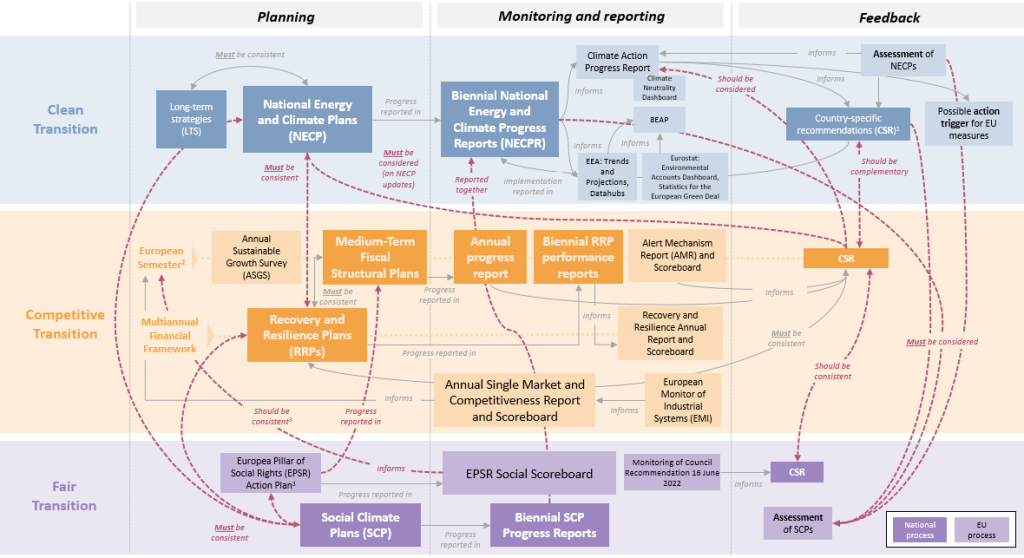
Note: (1) CSRs are provided as per the Governance Regulation in context of the Commission’s assessments (Art. 32, 34) as well as based on the draft NECPs and their updates (Art. 9, 14); (2) This presentation is not meant to represent the annual ‘timeline’ of the European Semester (e.g., the AMR comes at the start of each new cycle); (3) The EPSR Action Plan calls for mainstreaming of its principles across the European Semester.
EU-level reporting by the EU Commission under each pillar pulls from a range of sources relevant to the different topics. Our analysis of dataflows informing the Climate Action Progress Report, Annual Single Market and Competitiveness Report, and EPSR Scoreboard found that while there are few indicators common across all three instruments there is still substantial pairwise overlap between these. Moreover, Eurostat and the EEA serve as main data providers for over half of all relevant dataflows, with several EC platforms also playing a role.
Key messages:
- Siloed governance of mutually reinforcing priorities, while necessary to a degree due to the sheer complexity of the challenge, risks a fragmented approach to policymaking for the transition. The potential for added administrative burden and complexity is also inconsistent with the EU’s promise of a ‘simpler and faster Europe’ and ongoing efforts to streamline the EU acquis (see also the Ariadne paper, Evans and Duwe, 2025).
- EU governance of the clean transition would benefit from a concerted effort to better integrate key accountability processes across social, climate, and economic policy to ensure consistent action. This could take the form of inter alia an expanded common core set of KPIs relevant across all three areas as well as enhanced policy coordination at national and EU level, including EU support for Member States.
References:
EC. (2025). Communication from the Commission to the European Parliament, the Council, the European Economic and Social Committee and the Committee of the Regions: The Clean Industrial Deal: A joint roadmap for competitiveness and decarbonisation (No. COM (2025) 85 final). European Commission.
Evans, Nick & Matthias Duwe (2025): Smarter, simpler, more effective: Options to improve EU transition policy. Enhancing climate policy management through simplification Ecologic Institute, Berlin.
2.2. Financing the energy transition
Authors: Nikolas Messerschmidt (IER)
The European Union’s energy transition necessitates substantial upfront investments while simultaneously reducing traditional sources of public revenue, particularly from fossil fuel taxation. This creates a structural financing gap in which households are expected to bear financial burdens well before realizing the long-term benefits of reduced energy costs. Addressing this imbalance requires not only the identification of sufficient funding sources, but also the careful designing of mechanisms through which investments are channelled.
Beyond conventional policy instruments such as taxation or regulatory standards, government ownership and direct public investment through state-owned enterprises represent an alternative channel to facilitate technology deployment and accelerate the transition. These institutional arrangements introduce an additional layer of complexity, as the effectiveness of such investments depends on the characteristics and objectives of the respective public entities.
At the same time, the distributional consequences of climate policy are closely linked to the carbon intensity of household consumption. As consumption patterns evolve over time, they shape both the distribution of policy costs and the effectiveness of compensation mechanisms. Understanding these dynamics is therefore critical for designing policies that allocate public funds efficiently, mitigate adverse distributional effects, and ensure a socially balanced transition, particularly in light of the emerging financing gap.
2.2.1 The financing gap and consumption effects of the energy transition
Authors: Nikolas Messerschmidt, Annika Gillich (IER)
Setting the scene: The financing of the EU’s energy transition relies on a blend of public and private instruments as well as certain sets of rules, designed to address a multitrillion-euro investment gap. From a business perspective, the solution would be simple: at the time of the investment decision, a framework must be in place in which the expected future marginal revenues exceed the current marginal costs. Otherwise, funding must be provided through public sources.
A primary and obvious source of government revenue is taxation, which finances a substantial portion of public expenditures. However, in the context of the energy transition, significant fiscal challenges are expected to emerge in the near future. This can be illustrated using the example of Germany. In the 2021 fiscal year, the German federal government collected €98.2 billion in federal taxes. The largest share of this revenue – €37.1 billion – was generated through federal energy taxation. Notably, nearly 90% of the energy taxation revenue stemmed from levies on fuel consumption, particularly gasoline and diesel (Federal Ministry of Finance, 2022, p. 20). In contrast, revenue from electricity taxation was relatively modest, amounting to €6.7 billion (Federal Ministry of Finance, 2022, p. 21). It is to be expected that the revenues from taxes on fuel consumption will decline sharply, accounting for a large part of the investment gap (Pahle et al. 2025).
The most obvious solution to closing a financing gap is through government debt issuance. A government with elevated debt levels faces three principal mechanisms for servicing interest payments:
- Increase taxation
- Give out another bond to pay todays interest (and increase future payments further)
- Implement monetary expansion through central bank financing
All three mechanisms effectively constitute a form of wealth transfer that ultimately burdens households. Furthermore, bond market dynamics necessitate rising interest rates to incentivize continued purchasing, further increasing servicing costs (Plante, 2025).
To quantify the significance of this revenue shift and the actual burden on households, an agent-disaggregation framework has been implemented within the computable general equilibrium (CGE) model NEWAGE, enabling precise control and monitoring of global taxation flows throughout the model structure.
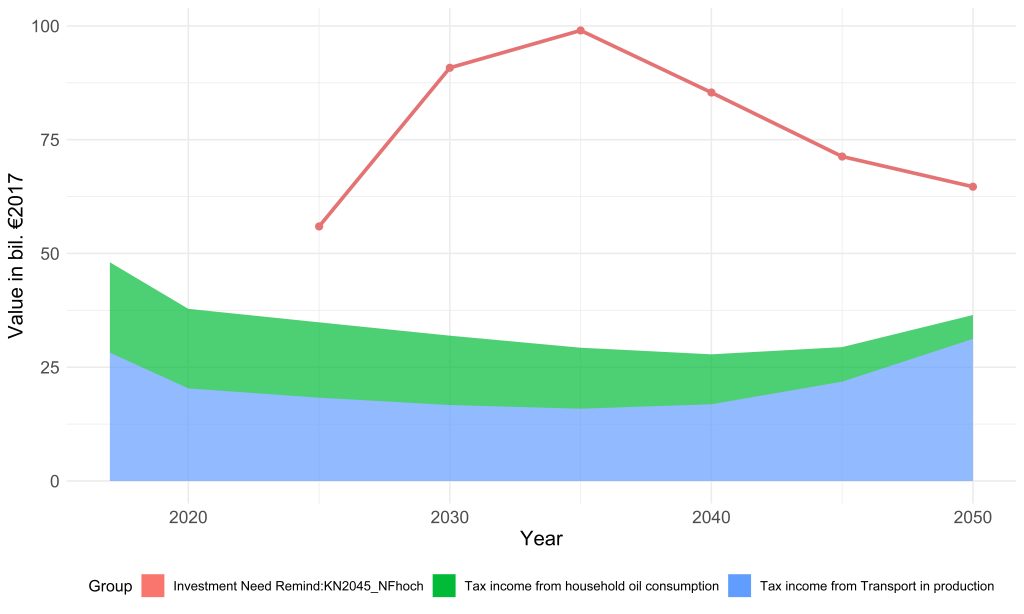
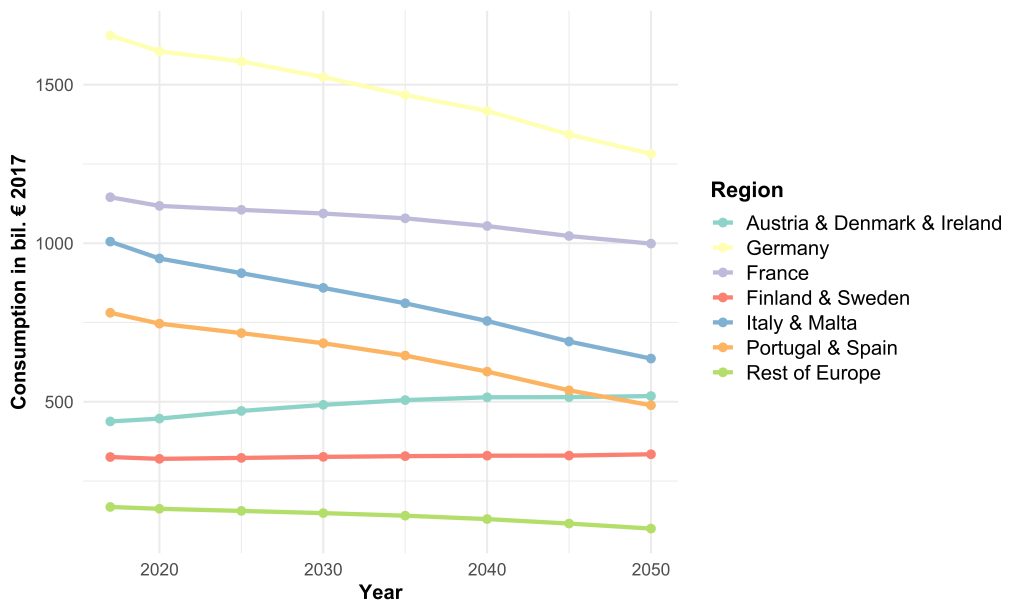
Results: As demonstrated in Figure 2, the temporal mismatch between investment requirements and available tax revenues presents a critical policy challenge. The highest annual investment requirements coincide with the lowest projected tax income from energy taxation in the NEWAGE model. Although postponing actual payments through debt accumulation offers short-term relief, the underlying burden ultimately manifests as a household-level adjustment, a pattern observable across almost all European member states (Figure 3).
Key messages:
- The energy transition can be conceptualized as an investment—an increase in costs today in exchange for lower energy expenditures in the decades to come. Our analysis highlights that a growing gap emerges between the scale of necessary investment in the energy system and the decline in tax revenues from traditional energy sources. As represented in the NEWAGE model, households bear the financial burden of the transition well before benefiting from lower energy costs, which may lead to issues of social and political acceptance.
Policy implications: It is of fundamental importance that governments strike a balance between allocating the costs of the transition to households and assuming a portion themselves to avoid fiscal erosion and excessive public debt.
References:
Federal Ministry of Finance, (2022). BMF Monatsbericht Januar 2022. https://www.bundesfinanzministerium.de/Monatsberichte/2022/01/Downloads/monatsbericht-2022-01-deutsch.html
Michael Pahle, Ulrich Fahl, Benjamin Görlach, Ronja Busch, Simon Feindt, Nikolas Messerschmidt, Jana Nysten, Sebastian Osorio, Darius Sultani et al. (2025): Staying the course in turbulent times: Insights on the current state and ways forward for the EU’s climate, energy and finance policy architecture. Kopernikus-Projekt Ariadne, Potsdam. DOI: 10.48485/pik.2025.008
Plante, Michael; Richter, Alexander; Zubairy, Sarah (2025). How sensitive are interest rates to higher federal debt?
2.2.2 Government Ownership as Policy Lever for the Diffusion of Technologies
Authors: Alyssa Kozian (ETH), Michael Pahle (PIK), Tobias S. Schmidt (ETH), Bjarne Steffen (ETH)
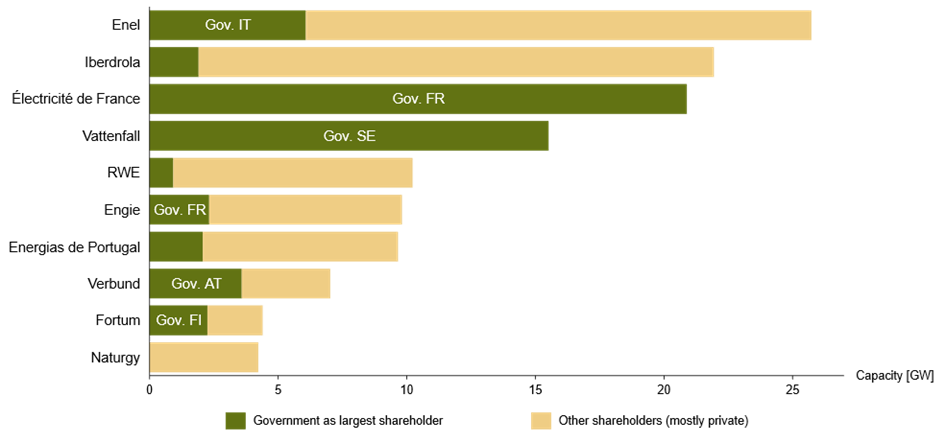
Setting the scene: Rapid diffusion of clean energy technologies is critical for meeting climate targets. However, achieving at least a 90 % reduction in GHG emissions in the EU by 2040 will require annual energy supply investments of EUR 341 billion during 2031–2040 – a 2.5-fold increase compared to the average annual investments between 2011 and 2020 (Pahle et al., 2025). To mobilize the necessary public and private capital, government support is essential. Most research examines government support through fiscal measures such as subsidies and carbon taxes, regulatory standards, or information-based interventions to raise awareness. Yet, government support can also take the form of direct market participation, where government-owned organizations act as investors. In the EU, nine out of the top ten renewable energy producers have either full or partial government ownership (Figure 4), underscoring their potential as direct market participants and their importance in the overall transition to clean energy. Existing research is inconclusive on how government-owned organizations affect technology diffusion, with limited studies examining the mechanisms through which these organizations exert their influence. Using an exploratory research design, we first synthesize insights across literature streams and then conduct an empirical case study on renewable energy deployment with expert interviews in Germany, Austria, and Switzerland.
Results: Our preliminary results indicate that government-owned organizations influence technology diffusion through five determinants, defined by government and organizational characteristics (Gunnemann et al., 2025). First, the technology mandate set by the government shapes investment decisions, with differences across governance levels reflecting industrial and energy policy priorities. Second, organizations operating under local governance are more likely to engage regional stakeholders and leverage existing social and institutional networks, thereby building legitimacy and lowering barriers to diffusion. Third, company size matters: greater experience, capacity, and resources enable faster action and more informed decision-making. Fourth, managerial autonomy increases organizational independence and efficiency in decision-making and execution. Fifth, government-owned organizations can deploy various financial instruments that have a de-risking effect, mobilizing private capital and accelerating technology diffusion.
Key message:
- There are different shades of government-owned organizations: risk-seeking vs. risk-averse technology mandates, national vs. local governance levels, big vs. small organizations, low vs. high managerial autonomy, and debt vs. equity financial instruments. These differences matter for the extent to which government ownership can accelerate technology diffusion.
Policy implication: When local legitimacy is critical, as in wind energy deployment, locally governed organizations can enhance social acceptance, thereby accelerating technology diffusion. However, local organizations are typically smaller in size and operate with less managerial autonomy, which can constrain their operational efficiency. For immature technologies with higher risk profiles, such as hydrogen production, nationally governed organizations—which are typically larger in size and operate with greater managerial autonomy—can accelerate diffusion by absorbing greater uncertainty, conditional on having a clear technology mandate.
References:
Michael Pahle, Ulrich Fahl, Benjamin Görlach, Ronja Busch, Simon Feindt, Nikolas Messerschmidt, Jana Nysten, Sebastian Osorio, Darius Sultani et al. (2025): Staying the course in turbulent times: Insights on the current state and ways forward for the EU’s climate, energy and finance policy architecture. Kopernikus-Projekt Ariadne, Potsdam. DOI: 10.48485/pik.2025.008
Alyssa Gunnemann et al. (2025). “The Role of the State in Sustainability Transitions: Scrutinizing the Various Effects of Public Ownership on Energy Infrastructure Innovation,” paper presented at 16th International Sustainability Transitions (IST) Conference, Lisbon, 2025.
2.2.3 The evolution of the carbon intensity of consumption of EU households over time
Author: Simon Feindt (PIK)
Setting the scene: The distributional impacts of climate policy are key determinants of public support for such policies. The central driver of these distributional impacts in the short run is the carbon intensity of consumption (CIC) of households and its distribution across income groups. The CIC is determined by consumption patterns and the carbon intensity of the goods consumed. So far, both researchers and policymakers have largely focused on one-time snapshots of households’ CIC. Yet the underlying factors are subject to change over time. For example, as a result of climate policy, the carbon intensity of goods might have decreased. However, shifts in consumption patterns towards more carbon-intensive products may offset this decline and lead to an overall increase of the CIC. Using an environmentally extended multi-regional input-output model combined with household consumption data, we examine the evolution of the CIC of households in 15 countries between 2005 and 2020 and identify primary drivers behind these changes.
Results: We find that the CIC has declined in nearly all countries and income groups, with the largest decrease in Poland, Slovakia, and Hungary (Figure 5). Notable exceptions include Greece, as well as the lowest income quintiles in Latvia, Lithuania, and Bulgaria. The changes in the CIC are heterogeneous across income groups: in ten out of 15 countries, richer households experienced larger decreases in the CIC than poorer households (in Greece, the CIC increased more among poorer households than among richer ones). Consequently, the short-term impact of a carbon price increase in 2020 would have been more regressive than in 2005.
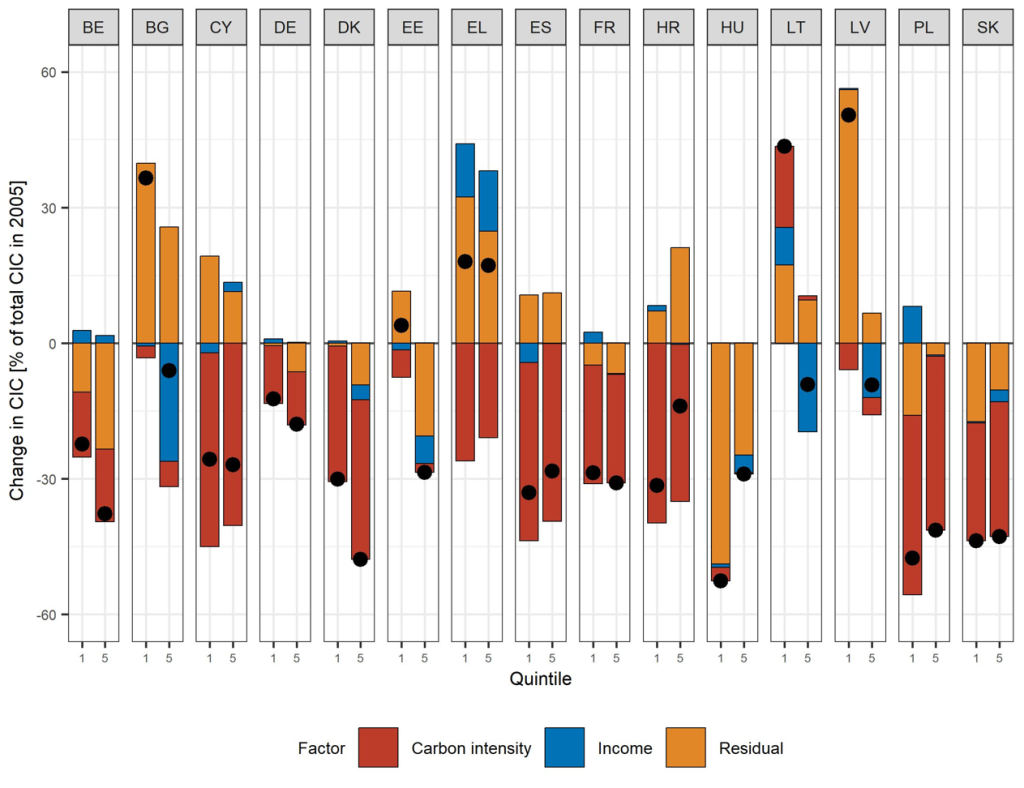
Based on an index decomposition analysis, we identify reductions in the carbon intensity of goods and services as the main driver of the CIC decreases. Changes in consumption patterns due to aggregate consumption increases account for only small shares of the overall change. The most important consumption categories are housing and transport energy. Their carbon intensity fell in most countries, although increasing expenditure shares have sometimes (partly) offset this progress.
Policy implications: Reducing carbon emissions without curbing overall consumption requires lowering the carbon intensity of goods. Country- and EU-level policies try to achieve this, but they risk affecting poorer households more strongly over time as the CIC of poorer households has often decreased less strongly than those of richer households. To mitigate such effects, a combination of short- and long-term measures is needed. In the short-term, instruments such as cash transfers can offset regressive impacts, while in the long-term, targeted investment schemes for poorer households are needed to prevent further increases in the CIC relative to richer households.
Key message:
- Climate policy affects poor and rich households differently. While the relative financial burden is falling in most countries, the disproportionate share of poorer households has increased in most EU countries in the last years. Climate policies should carefully balance short- and long-term measures to mitigate the unequal distribution of climate policy costs in the short run and the increase of the unequal distribution in the long run.
References:
Feindt, S., Lettow, F., Missbach, L. & Ward, H. (2025). What drives the distributional impacts of carbon pricing? Conference paper presented at EAERE and MCEE 2025. mimeo
3. The state of the three climate policy pillars industry, EU ETS, and infrastructure
In times where the gap between ambitious climate targets and the practical realities of a changing global economy appears to be widening, calls for refining the EU’s core climate policy pillars have emerged. The EU’s climate architecture rests on three interdependent pillars: the decarbonization of EU’s industry, the EU ETS that prices carbon and steers investment, and the energy infrastructure that integrates renewables and connects national energy systems. We focus on these three pillars because a weakness in any one risks undermining the others, and we now explore their current state and discuss possible modifications in light of the core challenges they face.
3.1 industry
EU’s industry stands at a pivotal crossroads. Decarbonizing heavy industry is both an economic imperative and a climate necessity, yet the path forward is riddled with competing risks, policy trade-offs, and structural vulnerabilities. The following subchapters examine the core challenges shaping the EU’s industrial green transition: how to design de-risking instruments that protect firms without overburdening the public budget, how to ensure that hydrogen funding flows toward the most climate-beneficial technologies, how carbon pricing reshapes the geography of steel production, how electricity and hydrogen markets interact under policy uncertainty, and how Europe’s clean-tech ambitions are constrained by its dependence on critical raw materials. Together, these contributions offer an exemplary, yet rigorous perspective on the policy architecture needed to make European industry both competitive and climate-neutral.
3.1.1 Optimal policies for de-risking breakthrough technologies in green industry transitions
Authors: Darius Sultani (PIK), Jules Welgryn (CEC Dauphine), Michael Pahle (PIK), Michael Jakob (Climate Transition Economics)
Setting the scene: Technological solutions for industrial decarbonisation are widely known. Green technology deployment, however, has still not occurred at scale and remains below socially optimal levels. Economic literature and policy have identified transition risks as a central hurdle for deep-decarbonising investments, hence arguing for de-risking policy instruments to support private actors in the green transition.
De-risking policy instruments like Carbon Contracts for Difference (CCfDs) are a central pillar of the EU’s decarbonisation policy strategy. Such instruments have been predominantly evaluated from a financial economics perspective, but welfare implications remain understudied. This gap needs to be addressed because, in practice, the regulator faces opportunity cost from safeguarding funds to insure against the worst-case scenario.
Approach: By taking the trade-off between regulator and producer risk into account, we aim to take a welfare-centric perspective to enhance the discussion and evaluation of de-risking policy interventions in green industry transitions. We develop a partial equilibrium model to illustrate socially optimal approaches to risk-sharing between regulator and producer. In principle, the regulator has two modes to support the firm in the green transition – risk-reducing and revenue-increasing intervention. In the analytical part of our work, we formalise a stylised version of the model and derive optimal policy parameters for these two modes. In a second, numerical part of the project, we analyse the firm’s production decision with two correlated risks (carbon price and green input risk) and different market failures (environmental externalities, incomplete markets).
Results: By considering welfare implications and the regulator’s opportunity cost from earmarked funds, we find that the optimal policy intervention depends on the trade-off between producer’s hedging cost, risk aversion, and the regulator’s cost of risk. While acknowledging that de-risking policy instruments have a central role to play in the green transition, we contribute to the literature and ongoing policy debate by highlighting that such interventions can be socially suboptimal when they transfer too much risk into the public budget.
Key messages:
- De-risking instruments like CCfDs impose a cost of risk on the public budget that is so far understudied.
- While de-risking instruments play an important role in the low-carbon transition, from a welfare perspective, mutualizing the cost of uncertainty comes at the risk of imposing a suboptimally high risk penalty (and hence social cost) onto the public budget.
3.1.2 Climate Policy in the EUs Funding and Financing Framework: The Case of Low Carbon Hydrogen
Authors: Nils Bruch, Michèle Knodt (all TUD)
Setting the scene: The EU adopted a regulatory framework to support the development of a hydrogen market, including for the controversially discussed non-renewable low carbon hydrogen (LCH). Fossil-based LCH is considered less beneficial for the climate than renewable and fossil-free hydrogen (e.g. based on nuclear energy), as its GHG emission reductions are higher and it comes with carbon lock-in risks that could otherwise be prevented. Funding and financing are crucial to increase the competitiveness of renewable and fossil-free hydrogen. But there is direct competition for a limited number of financial resources with established fossil-based technologies, including fossil-based LCH. This poses the question to which extent the EUs funding and financing framework favours the technologies best suited for its climate protection goals.
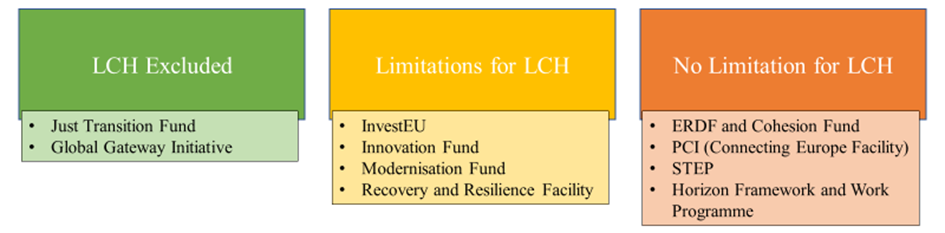
Results: Four funds and programs on the EU level include (fossil-based) LCH as an option to be supported without limitations. Only the Just Transition Fund and Global Gateway Initiative are exclusively funding renewable hydrogen projects (Figure 6). The remaining four funds introduce different types of limitations for non-renewable hydrogen, providing advantages for renewable hydrogen as the technology most beneficial for climate protection.
Furthermore, the EU framework provides rules for the use of state aid by member states set in the General Block Exemption Regulation, the Guidelines on State aid for climate, environmental protection and energy (CEEAG) and the Clean Industrial Deal State Aid Framework (CISAF). The frameworks are focused on renewable hydrogen but allow support of fossil-based LCH under certain circumstances. Furthermore, there are rules to ensure renewable hydrogen has an advantage over hydrogen less beneficial for the climate.
Policy implication: Support exclusively being available for renewable and fossil-free hydrogen would be most compatible with the EU’s climate policy objectives. Yet the use of limiting mechanisms for non-renewable hydrogen is providing a credible instrument to mitigate the diversion of funds from the most climate-beneficial solutions. The central mechanisms identified are i) limiting the share of funds for fossil-based LCH in favour of renewable or fossil-free alternatives, ii) requiring evidence for climate benefits, and iii) introducing a transitional regime.
Key message:
- The funding and state aid framework should be streamlined to couple funding and emission intensity. While some limitations for the use of fossil-based LCH is introduced, they are not implemented consistently throughout the framework. An exclusion or comprehensive restriction for the use of fossil-based LCH would ensure limited financial resources are used for technologies with the highest climate impact and strengthen the climate impact of the EU funding and financing framework.
3.1.3 EU Steel Sector Transition
Authors: Sebastian Osorio (PIK), Frank Best (HTWG Konstanz), Darius Sultani (PIK), Michael Pahle (PIK)
Setting the scene: Decarbonizing the European steel sector is pivotal for achieving the EU’s climate targets due to its significant emissions and central role in the economy. Technologically, decarbonization will be accomplished by phasing out coal-based steelmaking and shifting toward cleaner technologies such as electric arc furnaces and hydrogen-based direct reduced iron. However, policymakers are confronted with three crunch points that endanger political feasibility: High costs, relocation risks, and declining demand.
Results: Using the LIMES-EU model, we find that uniform carbon prices could drive future steel production away from traditional centers toward regions with lower energy costs. While this shift lowers costs and emissions, it may trigger political resistance and could provoke protective subsidies for national steel capacities. Government intervention could slow down the sector’s transition and increase public spending. These effects become more pronounced if future demand for EU steel declines.
Policy implications: Direct reduced iron (DRI) steelmaking capacities need to be ramped up swiftly within the next 15 years as electric arc furnace potentials are limited by scrap availability and quality constraints. Even in the face of political resistance against structural change, policymakers should carefully consider any intervention against comparative disadvantages from renewable energy cost. The steel sector’s low-carbon transition might seem easier if capacities are kept at current production centers, but protective subsidies run the risk of (i) going against state aid rules and (ii) creating stranded assets in the long run.
Key message:
- Uniform carbon prices could drive future steel production away from traditional centers toward regions with lower energy costs. Even in the face of political resistance against structural change, policymakers should carefully consider any intervention against comparative disadvantages.
3.1.4 Hydrogen and electricity prices in the European energy transition
Authors: Jonas Egerer, Natalia Goryashchenko, Veronika Grimm (all UTN); Sebastian Osorio, Michael Pahle (all PIK)
Setting the scene: Hydrogen is expected to play a crucial role in enabling Germany to achieve its goal of climate neutrality by 2045. A significant share of hydrogen is expected to be imported from within Europe and possibly from abroad. However, these projections are uncertain and often do not endogenously incorporate key market-based policies that influence hydrogen supply, pricing, or the price of (green) electricity used in hydrogen production. In particular, the role of the EU Emissions Trading System (EU ETS) – likely to be a major driver of hydrogen deployment – and complementary (national) energy market regulations are frequently overlooked. Another dimension is the role of uncertainty in future final energy demand with its implications on investment decisions and energy prices.
The analysis applies two complementary models: LIMES-EU, which offers a long-term perspective on EU ETS dynamics and power sector decarbonization, and the UTN market model, a power sector optimization model with hourly resolution, which captures the intricate interplay between electricity and hydrogen supply and demand.
Results: The regional allocation of investments in electricity and hydrogen production capacity and the resulting effects on energy trade and national electricity prices depend on different policy and import scenarios. Uncertainty on the future mix of final electricity and hydrogen demand results in different risk exposure for investments in renewable generation capacity, sector coupling technologies, energy storage and import infrastructure.
Policy implications: The study informs ongoing policy discussions on energy pricing in the transition to a de-fossilized energy system in Europe. It highlights the effects of national and EU-level support schemes for hydrogen market development and considers the impact of global hydrogen trade trends.
Key message:
- National policies on the development of local (green) hydrogen production and the built-up of hydrogen demand in industry will have an impact on regional investment decisions and on energy prices in the transition of the European energy system within the EU ETS.
3.1.5 Critical Raw Material Dependency and Clean-Tech
Authors: Henri Gruhl, Johannes Brehm (all RWI)
Setting the scene: Rare earth elements are indispensable inputs for many clean technologies, ranging from wind turbines to electric vehicles. Their unique magnetic and catalytic properties make them difficult to replace, creating a strong dependency on secure and affordable supplies. EU policy strategies such as the Clean Industrial Deal and the Critical Raw Materials Act already highlight the importance of securing access to these inputs for the transition to net zero GHG emissions.
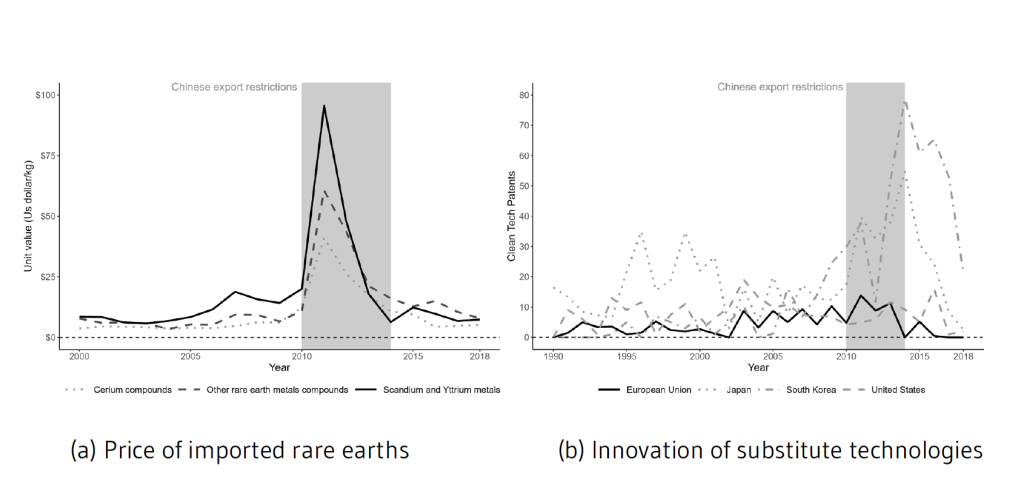
However, existing analyses often stop at mapping supply risks. Systematically analysing the text of all clean-tech patents to identify rare earth dependencies, and examining how innovation responded to supply shocks, reveals not only where dependencies exist, but also how the EU so far missed opportunities to steer innovation away from them (Gruhl et al., 2025). This dependency is especially pronounced in the energy and industry sectors, but also for transport and buildings, and it became highly visible when China, the dominant supplier, introduced export restrictions around 2010.
Results: As Panel a of Figure 7 shows, these restrictions triggered an unprecedented spike in rare earth prices, raising global concerns over supply security. One might expect such a shock to stimulate the development of substitute technologies that are less dependent on rare earth inputs. However, while Japan and South Korea responded to the supply shock with noticeable increases in patents for substitute technologies, suggesting deliberate innovation strategies to mitigate resource dependency, the EU showed only limited activity in this area, underlining structural weaknesses in aligning clean-tech innovation with resource resilience (Panel b).
Policy implications: These findings underline a critical vulnerability: clean-energy transitions depend not only on carbon pricing and technology support but also on resilient supply chains for critical raw materials. For policymakers, the lesson is that innovation and technological change can integrate resource security. Diversifying supply, investing in recycling, and actively supporting substitute technologies are essential to safeguard innovation pathways and ensure the robustness of the green transition.
Key message:
- Clean technologies rely heavily on rare earths, making them vulnerable to supply shocks. The 2010 Chinese export restrictions revealed that the EU lagged behind Japan and South Korea in fostering substitute innovations, underlining the need for policy strategies like the Clean Industrial Deal to link climate goals with raw material security and innovation support.
References:
Gruhl, H., Noailly, J., & Poelhekke, S. (2025). Rare Earths and Green Technological Change: Evidence from Chinese Export Restrictions. mimeo.
3.2. EU ETS
This section starts by examining whether the EU ETS has triggered innovation up until now and how prices are formed, focusing on the roles of hedgers and speculators. It then moves on to reform considerations, namely, how to potentially reform the Market Stability Reserve (MSR) to ensure market functioning in the future, and the legal basis for future reforms of the ETS and MSR more broadly. Finally, the focus turns to the international dimensions with an analysis of the welfare effects of CBAM for steel industry decarbonization and the macro-economic effects of different carbon leakage protection instruments related to the EU ETS.
3.2.1. The EU ETS and Clean-Tech Innovation
Authors: Henri Gruhl (RWI), Johannes Brehm (RWI)
Setting the scene: The EU ETS is the cornerstone of EU climate policy and the central instrument to drive decarbonisation. While its primary goal is to reduce GHG emissions, an equally important question is whether putting a price on carbon also stimulates innovation in clean technologies. This matters because technological progress is indispensable for reaching the EU’s climate and energy targets in a cost-effective way.
Results: New evidence from firm-level patent data shows that the EU ETS not only boosted low-carbon innovation among regulated firms but also reshaped how companies collaborate in research and development (Gruhl, 2025). Firms covered by the system increased their output of low-carbon patents, especially during phases II and III, and relied more heavily on joint inventions. Strikingly, these collaborations were strongest with non-competing firms outside the EU ETS, which already possessed valuable knowledge in clean technologies (Figure 8). This collaborative channel extends the effects of the EU ETS far beyond regulated sectors, creating positive spillovers that benefit the wider economy.
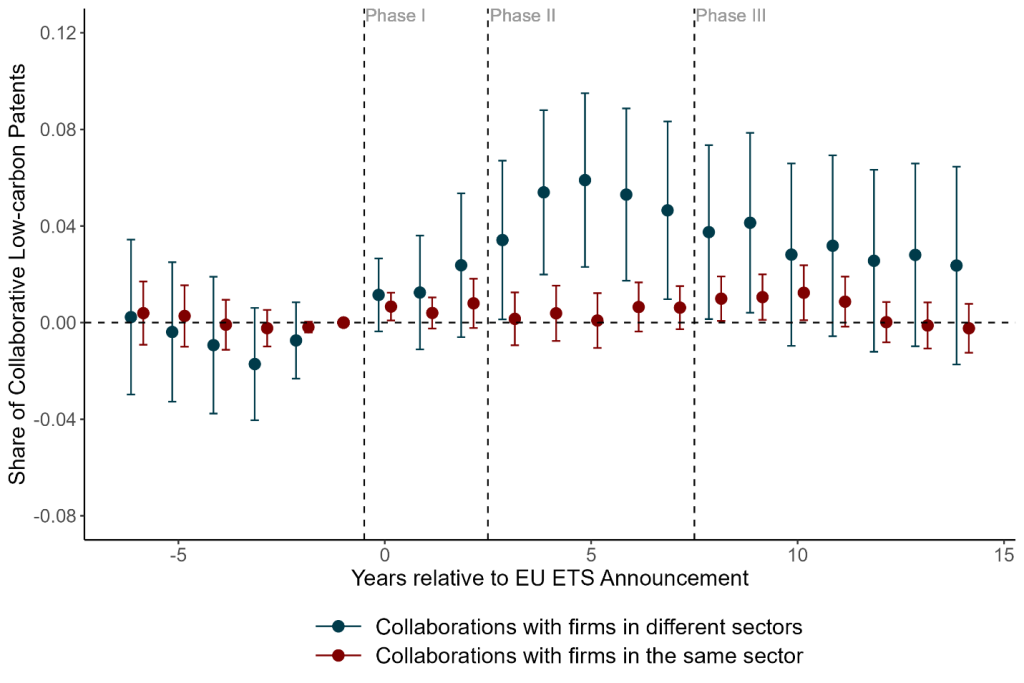
Policy Implications: These findings underline that carbon pricing delivers more than just GHG emission reductions. By incentivising collaboration, the EU ETS accelerates the spread of clean-technology know-how and strengthens innovation ecosystems. For policymakers, this demonstrates the value of carbon pricing not only as a tool for cutting emissions but also as a driver of long-term competitiveness in global clean-tech markets.
Key message:
- The EU ETS spurs clean-technology development in regulated firms and generates spillovers across the economy. It does so by encouraging collaborations that spread innovation beyond the boundaries of regulated sectors.
References:
Gruhl, H. (2025). Induced Innovation and Collaboration: Insights from European Carbon Pricing. mimeo.
3.2.2. The Role of Hedgers and Speculators in the EU ETS
Authors: Yassin El Hatri (UDE), Simon Quemin (EDF, PIK), Michael Pahle (PIK), Luca Taschini (University of Edinburgh), Rüdiger Kiesel (UDE)
Setting the scene: As the EU ETS has matured, financial actors have increasingly participated alongside obligated entities, raising concerns about the balance between hedging and speculative activities. Our contribution addresses the critical issue of distinguishing between these two types of trader behaviour and understanding their respective impacts on market dynamics.
Data and descriptive results: We analyse monthly futures on EU Allowances (EUA) traded on the Intercontinental Exchange (ICE). The data allows us to observe positions by individual contracts, though not by trader type. The evolution of open interest indicates that speculative activity is predominantly concentrated in front-year December futures, whereas hedging activity is more pronounced in March contracts and next-to-front-year December futures.
Additionally, following Quemin and Pahle (2023), we analyse weekly Commitment of Traders (CoT) reports, which provide aggregated positions by trader category across all futures and options. We distinguish long and short positions held by banks, funds, and commercial traders. Applying Working’s (1960) T-index reveals a growing share of positions that exceed hedging demand (Figure 9a). This trend is driven primarily by banks, although funds have also contributed recently. A closer look at banks’ net short positions and commercial traders’ net long positions shows a parallel development (Figure 9b), suggesting that banks and commercial traders predominantly trade with each other.
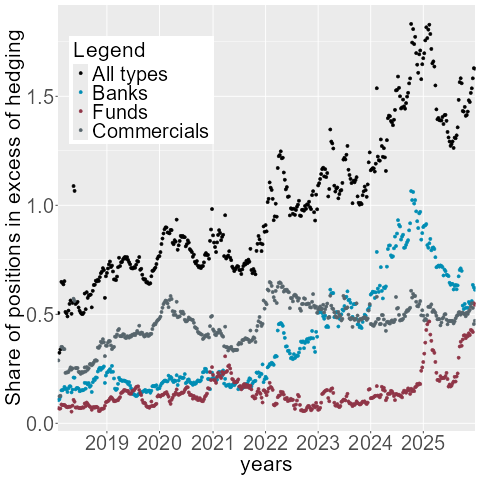
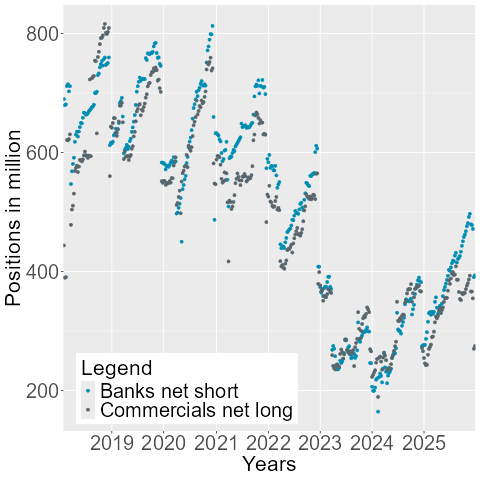
and commercial traders (own calculations) short positions by banks and net-long positions by commercial traders (own calculations) Source: Own presentation
Micro perspective and results: A crucial challenge is to relate the two datasets and use the term structure to infer who is hedging and who is speculating. An analysis of trading patterns for banks and commercials shows that banks’ short positions and commercials’ long positions typically go to settlement at the maturity of March and December contracts, indicating a clear role in hedging. To complement this, we construct speculation and hedging ratios based on volume and open interest following Lucia et al. (2015). The results reveal that funds are the only participants contributing significantly to the speculation ratio, whereas banks’ net short positions and commercials’ net long positions are the significant contributors to the hedging ratio.
Macro perspective and results: In commodity markets, empirical support for hedging theory has been weak. Kang et al. (2020) attribute this to differences between short- and long-term dynamics: in the long term, financial actors provide liquidity to meet the hedging demand of commercials, whereas in the short term, commercials supply liquidity for financial trading. Applying these observations to the EUA market is challenging for several reasons. Unlike most commodity markets, the EUA market is in contango, meaning futures are priced above expected spot prices and the hedging demand is predominantly net long. Moreover, trading activity is concentrated not in the front-month contract but in the front-year December contract, reflecting the market’s artificial structure and annual compliance cycle. Despite these differences, we find that changes in positions by funds significantly affect short-term returns, suggesting a role in liquidity dynamics. However, we cannot yet identify a consistent counterparty over the entire period. Current work focuses on disentangling short- and long-term trading activity of banks and commercials, which will provide a more complete picture of liquidity dynamics.
Policy implications: Regulators should consider targeted oversight mechanisms to ensure that speculative activity does not undermine the balance between achieving the EU’s climate target and ensuring the competitiveness of obligated entities. Achieving a clearer distinction between hedging and speculative positions requires enhanced data availability and greater transparency in market reporting. Particularly valuable would be Commitment of Traders (CoT) data disaggregated by individual futures contracts and a more granular classification of trader types.
Key message:
- Financial activity plays a substantial role in the EU ETS and should be carefully monitored to ensure it does not deplete the long-term liquidity required for effective hedging. Preliminary evidence suggests that funds may influence short-term price formation, but their role needs to be examined more closely.
References:
Quemin, S. and M. Pahle (2023). Financials threaten to undermine the functioning of emissions markets. Nature Climate Change 13.1, pp. 22–31.
Working, H. (1960). Speculation on Hedging Markets. Food Research Institute Studies 1387-2016-116000, p. 36.
Lucia, J. J., M. Mansanet-Bataller, and Á. Pardo (2015). Speculative and hedging activities in the European carbon market. Energy Policy 82, pp. 342–351.
Kang, W., K. G. Rouwenhorst, and K. Tang (2019). A Tale of Two Premiums: The Role of Hedgers and Speculators in Commodity Futures Markets. The Journal of Finance 75.1, pp. 377–417.
3.2.3. MSR and effects on the EU ETS
Authors: Frederik Schmitz (UHH), Grischa Perino (UHH), Michael Pahle (PIK), Sebastian Osorio (PIK)
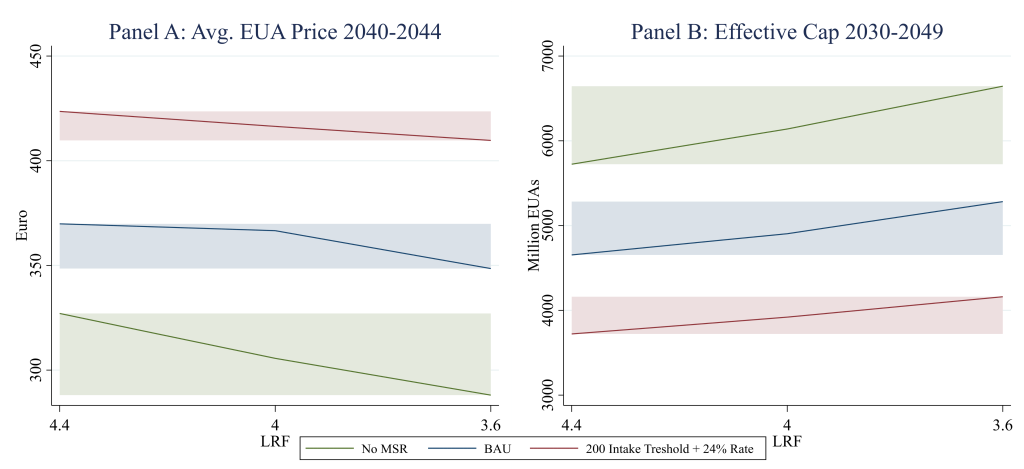
Setting the scene: The EU Commission must review the EU ETS Market Stability Reserve (MSR) in 2026. Although we do not anticipate that this review will lead to a fundamental overhaul of the core principles of MSR, it might well result in adjustments to the MSR intake rate and thresholds. Therefore, it is crucial to highlight how changes in these MSR parameters can influence allowance scarcity, especially in the post-2030 phase also called the EU ETS ‘endgame’. There have been calls to relax the long-run cap of the EU ETS, for instance, by reducing the linear reduction factor (LRF), including international credits (Art. 6 Paris Agreement), or by including allowances from carbon removal technologies. Hence, we investigate how these measures might interact, in terms of their impact on the EUA price and the effective emission cap.
Approach: Our analysis is based on the LIMES-EU linear dynamic cost optimization model (for a more detailed overview of LIMES-EU, refer to Osorio et al. 2023). To investigate the interactions between EUA supply changes and the MSR, we exogenously vary key design parameters of the EU ETS and the MSR. We look at three scenarios that start differing with respect to the MSR intake threshold and rate in 2030 (Table 1). Up to that point in time all scenarios are based on the current regulatory framework.
| Scenario | Intake Threshold | Intake Rate |
|---|---|---|
| BAU | 833 | 12% |
| No MSR | n.a. | 0% |
| 200 Intake Threshold + 24% Rate | 200 | 24% |
“BAU” represents the status quo without any changes to the legal framework of the EU ETS. “No MSR” sets the intake rate to zero in 2030, disabling EUA invalidation by the MSR and relaxing the emission cap. “200 Intake Threshold + 24 % rate” combines a low intake threshold with the extension of the doubled intake rate (24 % instead of 12%) after 2030 and represents the most ’aggressive’ design of the MSR among the scenarios considered here. For each scenario, we consider different linear reduction factors (LRFs) ranging from 4.4 % (status quo) to 3.6 % to identify how exogenous variations of the supply of allowances interact with adjustments of key MSR parameters.
Results: Simulation results are shown in Figure 10. A reduction in the LRF causes an increase in the effective cap and a reduction in the EUA price in all scenarios. However, a simultaneous reform of the MSR could more than offset these changes. For example, if a reduction in the LRF from 4.4 % to 3.6 % is accompanied by an MSR reform lowering the intake threshold and keeping the intake rate at 24% beyond 2030, the effects are reversed. Within the scenarios considered, an MSR reform has a stronger impact on the effective cap, i.e. the climate, and on prices than changes in the LRF. Although the MSR was designed to buffer shocks in allowance demand, it has the same effect on changes in supply originating from other interventions such as changes in the LRF or inclusion of CDR or international credits in accordance with Art. 6 of the Paris Agreement. In short, the more effective the MSR, the smaller the impact of any other intervention on the long-run cap (see Panel B of Figure 10). The effects of changes in MSR parameters and the LRF on the Total Number of Allowances in Circulation (TNAC) are ambiguous, highlighting the sensitivity of the TNAC to changes in anticipated future scarcity as well as current market tightness (Borghesi et al. 2023).
Key messages:
- Adjustments in the intake threshold and the MSR intake rate can increase the effective cap between 2030 and 2050 by approximately 50% up and down. This is about twice the impact of changing the LRF from 4.4. to 3.6.
- How much changes in the LRF affect the effective cap is moderated by the design of the MSR. The more potent the MSR, the less effective are other interventions that aim at adjusting the supply of allowances. This would also extent to allowing international credits in accordance with Art. 6 of the Paris Agreement.
Policy implications: The review of the MSR is crucial for the future of the EU ETS and European industries. The design details of the MSR substantially affect the effective supply of allowances in the two decades following 2030. Hence, they are a fundamental driver of overall scarcity and market liquidity. Moreover, the responsiveness of the MSR, which is governed by the same parameters, affects how well it responds to shocks occurring during the ’endgame’ of the EU ETS. Note that previous research has shown that the MSR is effective in buffering unexpected, instantaneous shocks but amplifies the market response to any change in expectations (Borghesi et al. 2023).
References
Borghesi, Simone et al. (2023). “The Market Stability Reserve in the EU Emissions Trading System: A Critical Review”. In: Annual Review of Resource Economics 15, pp. 131–152.
Osorio, Sebastian et al. (2023). Documentation of LIMES-EU-A long-term electricity system model for Europe. URL: https:// www.pik- potsdam.de/ en/institute/departments/transformation-pathways/models/limes/ documentation-of-limes-202508_vf.pdf.
3.2.4. Legal Basis for a(ny) revision of the EU ETS (1 and 2)
Authors: Dr. Jana Nysten, Dr. Markus Ehrmann (all Stiftung Umweltenergierecht)
Setting the scene: The EU Commission is preparing a report on the functioning of the European Emissions Trading System Directive (EU ETS) Directive and several proposals for its reform are in the discussion2In October 2025, the president of the European Commission wrote a letter to the EU Member States announcing several changes to the Emissions Trading System. See e.g. Reporting by Euractiv: Von der Leyen teases tweaks to EU green policies in letter to leaders, last visited 17.11.2025. The ETS Directive is up for review and a report on its functioning is due by 31 July, 2026, which may go accompanied by a legislative proposal. See Art. 30(5) ETS-Directive.. Every future revision of the Directive establishing a European emission trading system (EU ETS Directive) needs a proper legal basis and respective procedures need to be followed; otherwise, the legislation can be declared void by the European Court of Justice (ECJ). So far, the environmental competence in Art. 192 par. 1 TFEU has been used, and it is assumed the EU ETS Directive will – even after potential future amendments – continue to pursue mainly environmental protection purposes, i.e. climate protection. Hence, Art. 192 TFEU will in prin-ciple remain the appropriate legal basis. However, the environmental competence of Art. 192 TFEU distinguishes between measures that need to be adopted under the ordinary leg-islative procedure, i.e. jointly adopted by the European Parliament and the Council by (quali-fied) majority voting ((Art. 192(1) TFEU)), and measures that require a special legislative procedure (Art. 192(2) subpar. 1 TFEU). The latter would require a unanimous vote in the Council, with mere consultation of the European Parliament. Such an unanimity requirement may constitute a significant hurdle in the legislative procedure. The decisive factor thereby is whether the legislation constitutes (inter alia) “provisions primarily of a fiscal nature” (Art. 192(2) subpar. 1 lit a) TFEU) or “measures significantly affecting a Member State’s choice between different energy sources and the general structure of its energy supply.” (Art. 192(2) subpar. 1 lit c) TFEU3Note that Art. 192(2) subpar. 1 lit b) TFEU subjects “measures affecting: town and country planning, quantitative management of water resources or affecting, directly or indirectly, the availability of those resources, land use, with the exception of waste management;” to the special legislative procedure as well; however, those are not considered within the scope of our works.).
Approach: Some authors have discussed the appropriateness of Art. 192(1) TFEU as legal basis for reforms of the EU ETS Directive with regard to specific reform proposals. We, however, seek to provide more general guidance applicable to multiple scenarios. Hence, we examine the provisions of the EU Treaties itself, the case-law of the European Courts, as well as the relevant literature to find out under which conditions Art. 192(2) subpar. 1 lit. a) and c) TFEU would apply. The criteria we derive from that examination may be applied to practical examples, which may enhance the understanding of the legal provisions.
Results: The EU ETS Directive constitutes the central instrument the EU uses to achieve Union-wide GHG emissions reductions and protect the climate. It has so far been based on Art. 192(1) TFEU and for many reforms that provision has provided – and will continue to provide – the appropriate legal basis. Only in exceptional cases, the special legislative procedure under Art. 192(2) subpar. 1 TFEU will need to be followed4According to Art. 192(2) subpar. 2 TFEU the Council can decide by unanimity, that the ordinary legislative procedure shall apply in the cases of Art. 192(2) subpar. 1 TFEU. This provision (“Passerelle clause”) could provide a solution in cases where there is no agreement on whether the ordinary or the special legislative procedure have to be followed. The unanimity requirement in the Council would protect the interests of the Member States, while the European Parliament would still get to vote.:
According to our analysis of the relevant case-law, “provisions primarily of a fiscal nature” thereby refers to provisions that
- Are intended to create budget revenue/have a relation to the budget; and/or
- Do not offer any rights in return to payment obligation; and/or
- Wherein the price to be paid is not determined by the market.
It is however not clear from the case-law whether one or all of those criteria need to be met for a provision to become primarily fiscal in nature. With regard to the EU emissions trading system for industry and energy (EU ETS 1), the European Court of Justice (ECJ) has so far held that EU ETS 1 would not contain provisions primarily of a fiscal nature5ECJ, C-366/10 United Airlines, 21.12.2011.:
However, depending on the goals and content of legislative amendments, such may have changed or may change.
Measures triggering the special legislative procedure for significantly affecting the energy sovereignty of a Member State will include such that
- are intended to restrict a Member State’s choice between different energy sources and the general structure of its energy supply;
- where the effects are not merely indirect in nature.
In the field of climate protection, the ECJ thereby seems to see a higher threshold for what counts as “significantly affecting” may be assumed6ECJ, C-5/16, Polen v Parliament and Council, 21.06.2018, para. 41ff..
Policy implications: A(ny) reform of the EU ETS Directive requires an appropriate legal basis in EU law and the respective procedures need to be followed. Considering the need for unanimity in the Council, and the restricted rights of the European Parliament under the special legislative procedure, reform proposals that would trigger its application may need more (political) preparation.
Key messages:
- A(ny) proposed amendments to the EU ETS Directive should be examined as to whether they change the aim and content of the system in a way that turns it into “provisions primarily of a fiscal nature” or significantly affects a Member State’s energy sovereignty.
- The special legislative procedure, with unanimous voting in the Council, while only consulting the Parliament, will only be required in exceptional circumstances, notably when the goal and content of the EU ETS Directive is changed.
Related products:
Nysten, J. V. & Ehrmann, M. (2026), EHS Evolution, Die Möglichkeiten und Grenzen des Art. 192 AEUV als Rechtsgrundlage für die Weiterentwicklung der EU-Emissionshandelsrichtlinie, Würzburger Studien zum Umweltenergierecht.
3.2.5. The Welfare Effects of Border Carbon Adjustments for Steel Industry Decarbonization
Authors: Eunseong Park (ZEW and University of Mannheim) and Sebastian Rausch (ZEW and Heidelberg University)
Setting the scene: As a key pillar supporting the EU ETS 1, the Carbon Border Adjustment Mechanism (CBAM) is a cornerstone of the strategy to prevent carbon leakage and ensure a level playing field for domestic producers. It is intended to shield key European industries, with the steel sector being among the most exposed to these pressures. However, the policy’s design presents critical challenges to both its economic and environmental goals. The lack of support for exports raises concerns about the international competitiveness of EU firms, while structural loopholes risk merely reshuffling emissions-intensive trade to other regions instead of reducing them globally.
Results: Based on our novel structural equilibrium model of the global steel market with plant-level resolution, the EU CBAM appears successful in its goal to curb relocation of emissions. It mitigates carbon leakage, reducing the leakage rate by 15–20% compared to a scenario with the EU ETS alone. Despite its overall positive effect on mitigating carbon leakage, we find that the EU CBAM creates structural loopholes – such as product reshuffling to non-regulated countries and diverted international trade in downstream products not covered by the regulation – which undermine its environmental effectiveness. What is more, the overall positive environmental effect does not come without trade-offs. The current design could weaken the competitiveness of EU steel produces on exports markets outside of the EU. On average, the share of EU-produced steel in international (non-EU) export markets declines by 25% due to the introduction of the EU CBAM.
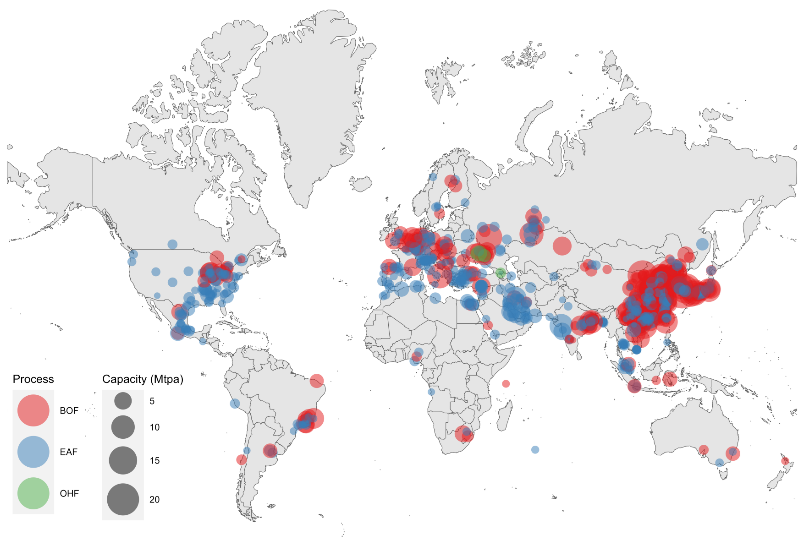
Policy implications: To improve the performance of the EU CBAM, its design could be refined. A WTO-compliant solution to address the potential decline in export competitiveness appears to be a key consideration. At the same time, the mechanism’s scope could be broadened to include downstream products, which might help to close loopholes related to emissions shuffling and indirect leakage. These domestic adjustments could be complemented by a proactive strategy to forge climate alliances with key trading partners, which may improve effectiveness and help ensure a level global playing field.
Key messages:
- The EU CBAM is an important step, but its current design presents a complex picture. While it appears to shield EU producers from carbon leakage at home, it may also affect their competitiveness abroad and has loopholes that could reduce its global impact.
- Realizing the full potential of CBAM likely involves adjustments to support exporters and expand its scope, ideally in coordination with international partners. Our plant-level analysis provides a critical analytical foundation for these ongoing policy deliberations within the EU Commission, offering the empirical evidence necessary to guide these essential refinements.
References:
Karplus, V., E. Park, and S. Rausch. (2025). The Welfare Effects of Border Carbon Adjustments for Steel Industry Decarbonization. mimeo.
3.2.6. Macroeconomic Effects of Different Carbon Leakage Protection Instruments
Authors: Lena Kittel (IER), Ulrich Fahl (IER), Annika Gillich (IER)
Setting the scene: In order to accelerate the EU’s transition to climate neutrality while maintaining the competitiveness of European companies and avoiding the risk of large parts of the industry migrating to less ambitious regions, the European Commission has decided to replace the current system of free allocation with a Carbon Border Adjustment Mechanism (CBAM). This instrument is intended to align the carbon prices of imported goods with the higher price that European companies have to pay for their production under the EU Emissions Trading System 1 (EU ETS 1). We use the general equilibrium model NEWAGE to compare the effects of the carbon leakage protection measures free allocation and CBAM in terms of macroeconomic indicators and CO2 emissions: In addition to the comparison between CBAM and free allocation, the possibility of establishing a climate club in different design variants to expand the protection of the public climate good and avoid carbon leakage is analysed.
Results: Figure 12 shows the impact of the European Green Deal (Ref_GreenDeal), the free allocation (EU_FreeAllocation), the CBAM (EU_CBAM) and a combination of free allocation and CBAM (EU_CBAM_FrAllocSec) on key figures, namely global emissions, carbon leakage and economic development. This cluster of scenarios shows that an increase in climate protection ambitions within the EU27 leads to a comparably small overall global reduction in emissions (less than 1%), if no additional carbon leakage instruments are implemented. However, each of the carbon leakage protection instruments examined can increase the global emission reduction to a level of between 1 and 2%. The same applies to the possibility of establishing climate clubs in different designs, which is not part of the result summary in Figure 12, but details can be read in Kittel & Fahl 2025.
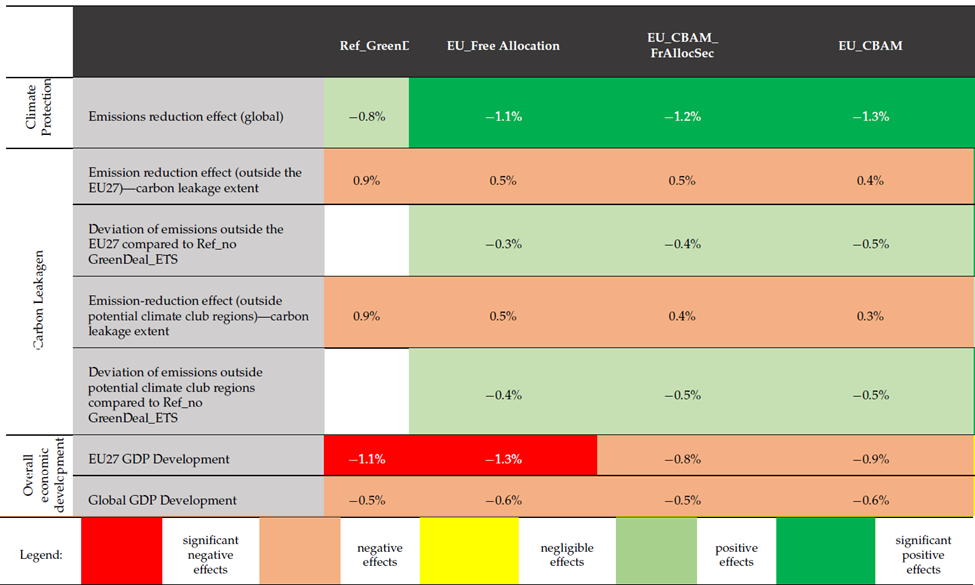
The second cluster of global policy scenarios also considers different climate protection ambitions of the US. Results show that an increase in climate protection ambitions outside the EU27 generally leads to more advantageous effects than Europe doing it alone, both in terms of climate protection and economic impacts.
Key messages:
- Carbon leakage protection instruments are key to protect regulated industries and can prevent the erosion of more ambitious European reduction efforts at a global level.
- The establishment of a climate club with a uniform carbon price among member states together with a common CBAM on imports from non-member states is a favourable policy solution, especially if ambition levels outside the EU are low.
Policy implications: Among all the scenarios considered in the analysis (see Kittel & Fahl 2025 for details), a climate club solution with a uniform carbon price among member states together with a common CBAM protection mechanism against imports from less ambitious regions show the best results in terms of emission reduction and GDP impact. The more regions that actively participate, the more likely it is that as many SDGs as possible will be achieved at the same time.
References:
Kittel, Fahl (2025): Carbon Leakage Protection—Model-Based Comparison of the Macroeconomic Effects of Different Instruments. Sustainability 2025, 17(6), 2579; https://doi.org/10.3390/su17062579
3.3. Infrastructure
Energy infrastructure constitutes a critical element in the pursuit of climate neutrality by 2050. A number of EU-level legal instruments, including both regulations and directives, have already taken effect. Therefore, this section examines the topic at both the legal level and the energy system level. It analyses the Renewable Energy Directive (RED) from a legal perspective, focusing on its implications for national implementation and possible challenges. Additionally, it assesses the electricity interconnection target for 2030 and beyond, highlighting potential operational and strategic considerations and providing recommendations for effective planning and coordination.
3.3.1 Rethinking spatial and infrastructure planning: Climate protection as a challenge of land use management
Authors: Sabine Schlacke, Christoph Plate, Eva-Maria Thierjung (all IfEUS)
Setting the scene: Since the amendment of the Renewable Energy Directive (RED III) in 2024, the Directive contains for the first time comprehensive requirements regarding the planning and permitting procedures for renewable energy (RE) plants and the associated infrastructure. The promotion of the use of renewable energy sources (RES) – the directive’s primary aim – is still pursued through financial support but is now also subject to acceleration measures. To this end, the Directive contains well-coordinated procedural simplifications: member states are obliged to designate so-called Renewable Acceleration Areas (RAAs). Additionally, they may adopt one or more infrastructure areas for the development of grid and storage projects that are necessary to integrate renewable energy into the electricity system – in both areas RES projects shall benefit from exceptions to certain environmental and nature conservation regulations, thus accelerating the RES roll-out. Moreover, the RED III declares RES projects as being in the “overriding public interest”. This new regulatory framework shows that the EU legislator has recognized that spatial planning is a key element of the energy transition. However, virtually all climate measures require land resources. The comprehensive prioritization of RES projects laid down in the RED III and the resulting strong focus on technological climate protection measures therefore create numerous challenges.
The RED III creates a new legal framework for spatial planning and permitting procedures at the EU level. It requires the member states to, firstly, map the areas necessary to achieve the RED’s renewable energy targets. On the one hand it forces the member states to designate RAAss based on certain criteria by February 2026. The designation of infrastructure areas, on the other hand, is optional for member states. The main legal instrument to accelerate ReES deployment consists in shifting the assessment of RE plant’s environmental impact from the permitting to the planning stage: Essentially entailing the limitation of environmental impact assessments to the (abstract) planning stage and dispensing with them at the project-related level. Member states must identify ‘low-conflict’ areas, in which the realization of RES projects is expected – based on suitable data – not to have a significant environmental impact. Thus, member states shall ensure these areas are particularly suitable for the installation of RE plants or infrastructure projects. This process includes a Strategic Environmental Assessment and, if necessary, an Appropriate Assessment under the Habitats Directive. According to the European legislator’s concept, this careful selection procedure justifies the fact that, when implementing RES projects in these areas, the permitting procedures are simplified (read: quicker): Above all, exemptions from nature, species and water protection laws apply. This is based on the assumption, that the conflict between nature protection sensu stricto and climate protection was already solved at the higher, i.e., the planning level. So, the new acceleration mechanism is essentially based on the concept of sphere separation. It appears questionable how this idea is compatible with the fact that land is a finite resource under increasing pressure: both nature conservation and climate protecting measures require space.
In August 2025, after the new government was formed, the German legislator initiated the transposition of the RED III. Shortly thereafter, a law implementing the Directive’s provisions concerning the designation of RAA for onshore wind energy plants was adopted (BGBl. 2025 I No. 189 from 14.8.2025) The legislative procedure for offshore RAA as well as for infrastructure areas, both off- and onshore, was completed only in December 2025 (BGBl. I 2025, No. 351 from 22.12.2025).
The German lawmaker has not exploited the full potential of RED III: they have focused the implementation measures on wind energy. Both onshore and offshore, RAAs are only to be designated for wind turbines. Notably, there are no RAAs (planned) for PV, unlike in the draft of the previous government.
Accordingly, infrastructure areas can only be designated for transmission grid projects, 100 kV lines and offshore connection lines – these parts of the grid, which are needed to “bring the electricity produced by wind farms into the system”. Additionally, the “design” of these measures makes the acceleration effect appear questionable. Although they eliminate the necessity for a double assessment under environmental law, in particular nature conservation law, and partially dispense with assessments in comprehensive spatial planning, the accelerated deployment of RE ultimately requires innovation, which in turn depends on legal certainty. However, these legal novelties create legal uncertainty, not least because, from a national, legal-dogmatic perspective, they represent a (wild) mixture of project-related provisions as well as large-scale spatial planning (gesamträumliche Planung). This regulatory approach does not easily align with the complex, multilevel German planning and permitting system, making the transposition of the Directive’s requirements particularly challenging.
Policy implications: The main task for the German legislator is to render the legal reforms operational, i.e., to remove legal uncertainties. Speaking from a legal policy perspective: Not (only) a ‘pure’ transposition is required, but also the integration of the new laws into the existing member state’s system as far as possible – through clarifications, definitions and specifications. For example, provisions concerning the plans designating RAAs and infrastructure plans within the common planning levels and mechanism are badly needed.
At the EU level, the idea of multifunctional land use, expressed in Art. 15b (3) RED III, should be further defined, addressing the problem of land scarcity effectively and in the long-term perspective; however without imposing new requirements on the member state. The EU legislator should give them time to transpose and implement the last wave of new legislation. Nevertheless, the German legislator should take up this concept and develop it further. A first step in this direction was taken in July last year, when section 7(1) of the German Regional Planning Act (ROG) was amended. Now, this provision has a new sentence 2, defining multifunctional land use as the stipulation that certain areas of the planning area are intended for several compatible uses and functions. However, this cannot be regarded as sufficient since no concrete guidance can be derived from it. Rather, the concept of multifunctional land use should be integrated more strongly into the ROG and, above all, into the German Federal Building Code (BauGB), so that multifunctional land use would get established as a guiding principle of large-scale spatial planning.
Key messages:
- Right now, the German transposition of the new legal framework for planning and permitting procedures of the RED III is more of a patchwork added on the existing provisions than a full and coherent integration, implying a lot of legal uncertainty and considerable need for clarification. These have to be addressed by the national legislator for the reforms to have the desired acceleration effect. Afterwards, an extension of Renewable Acceleration Areas or infrastructure plans, for example for PV or storage facilities, should be considered.
- To unlock the full potential of the RED III, multifunctionality – as laid down in Article 15b (3) RED III – should be anchored as a guiding principle in Germany’s planning law. Amending section 7 (1) of the German Regional Planning Act and entailing a legal definition of multifunctionality within this provision is to be welcomed, but further reforms are needed to this law and, above all, to the BauGB (German Federal Building Code) in order to establish multifunctionality of land as a guiding principle of large-scale spatial planning in German law.
References:
Schlacke, S. (2026), Written statement for the public expert hearing of the German Bundestag’s Committee on the Environment, Climate Action, Nature Conservation and Nuclear Safety on the draft Infrastructure Future Act (BT-Drs. 21/4099), 25 February 2026 (Committee Printed Paper 21(16)105 – Ausschussdrucksache 21(16)105)).
Schlacke, S. (2025), Beschleunigung durch Infrastrukturgebietsausweisung? – die horizontale Perspektive, Presentation on the Science Dialogue „Spannung auf allen Ebenen: Stromnetzausbau zwischen Beschleunigung, Umweltstandards und Beteiligung“ organised by the Federal Network Agency (Bundesnetzagentur), Bonn, 30.9.2025
Schlacke, S. (2025), Standort, öffentliches Interesse und RED III aus deutscher Sicht, Presentation at the Austrian Environmental Law Conference, Johannes-Keppler-Universität Linz, Institut für Umweltrecht, Linz, 17.9.2025
Schlacke, S., Plate, C. & Thierjung, E. (2025), Beschleunigung des WEA-Ausbaus: Befund, Umsetzung, role model – eine Zwischenbilanz, NVwZ 2025, pp. 441-446
Schlacke, S. (2024), Multifunktionale Flächennutzung: Potentiale und Grenzen des Raumordnungsrechts, in: Schlacke, S. (ed.), Multifunktionalität von Flächen – Symposium des Zentralinstituts für Raumplanung an der Universität Münster, 6 November 2023, 2024, pp. 83-107
Schlacke, S. & Plate, C. (2024), Multifunktionale Flächennutzung: Potentiale und Grenzen des Raumordnungsrechts, ZUR 2024, pp. 323-331
3.3.2 Reaching the EU interconnection target for 2030
Authors: Dr. Jana Nysten, Fabian Pause (all Stiftung Umweltenergierecht)
Setting the scene: The EU has committed to reaching 15% electricity interconnection by 2030. However, the progress in transnational electricity infrastructure has been criticized as being (too) slow. For example, the 2024 Draghi report highlighted the issue and proposed a 28th – thus EU-level – regime for interconnectors, and the EU Commission itself is planning a European Grids Package as part of the Clean Industrial Deal by the end of 2025. Before discussing reforms of the system, or the adoption of a new one, it seems important to get clarity about the status quo.
Approach: There is hardly any literature on the EU interconnection target. Hence, we examine relevant EU law and policies with a view to the nature and content of the 15 % interconnection target to 2030. We examine relevant political declarations as well as the (scarce) legislative acts that mention the target and sketch how the interconnection target has emerged and evolved, including the legislation the EU has so far put in place to achieve the target. The declared goal is finding an answer to how the 15% interconnection target currently works, and how it can serve as a basis for future initiatives.
Results: The 15% electricity interconnection target goes back to Council Conclusions from 2014. In October of that year, the European Council affirmed the intention to reach 10% interconnectivity, asking the European Commission “supported by the Member States” to ensure such minimum level is met by 2020. They also raised the perspective of achieving 15 % by 20307European Council, EUCO 169/14, Conclusions 23./24.10.2014, par. 4.. The latter target has made it into Art. 2(11) Governance Regulation which also establishes a system in which the Member States are asked to contribute to the achievement of the EU interconnection target.
Originally, the interconnection target was understood as a function of the Member States’ installed electricity production capacity8[1] See e.g. European Council, EUCO 7/1/14, Conclusions 21.03.2014, par. 19. However, over the years, and influenced by the works of an Expert Group specifically installed to report on the target, that reference point has been replaced by a set of indicators: When setting the interconnection level they aim for, the Member States shall look at whether
- the price differential in the wholesale market is exceeding an indicative threshold of EUR 2/MWh,
- the nominal transmission capacity of interconnectors is below 30 % of peak load;
- and the nominal transmission capacity of interconnectors is below 30 % of installed renewable generation.
So, nowadays, and subject to those indicators, Member States determine themselves the level of interconnection they aim for. The construction of new interconnectors is also subject to a cost-benefit analysis (see Annex I Part I par. 2.4 Gov-Regulation).
Policy implications: In the European Council, the Member States have committed to a target of 15% electricity interconnections by 2030 and they have mandated the EU Commission to work on its achievement.
Acting on that mandate may include revisions of the relevant legal framework in the course of the EU Commission’s European Grids Package, notably the proposal to reform the TEN-E Regulation and the governance framework for infrastructure development.
Key messages:
- The interconnection target of 15% to 2030 constitutes a strong political commitment by the Member States to improve transnational electricity infrastructure.
- The European Commission is mandated to – supported by the EU Member States – to achieve the EU’s interconnection target.
References:
Nysten, J. V. (2025), 15% interconnection to 2030 – Understanding the EU‘s electricity infrastructure development target, Presentation Ariadne@Brussels, https://ariadneprojekt.de/media/2025/12/5_AriadneInput_Nysten.pdf
3.3.3 EU interconnection target beyond 2030
Authors: Peiwen Zhang, Prof. Markus Blesl, Dimitris Tsoutsoulopoulos (IER)
Setting the scene: The objective of this study is to model the infrastructure development beyond 2030 on the EU level under existing regulations and energy prices from World Energy Outlook (IEA, 2022), followed by examining the impact of the interconnection target from an energy system perspective by further developing the energy system model TIMES PanEU, in order to give insight into the pathway of reaching climate neutrality on the EU level. It is still important to see whether the EU can use this target as a helpful “instrument” to regulate the path towards climate neutrality.
According to the report from the Commission Expert Group (Sikow et al., 2017), there are two definitions for the interconnection target:

Two scenarios are proposed for the simulation:
- Business-as-usual (BAU): countries only build up moderate capacities according to existing plans like TYNDP (ENTSO-E, 2024; ENTSOG, 2025) and European Hydrogen Backbone (EHB, 2023)
- High interconnection level (150%): countries realize the importance of interconnection and start to make regulations on national levels and build up grids massively and quickly, assumed 150% more than existing plans starting from 2030.
Results: No matter which definition is applied, increasing the electricity interconnection capacity can positively raise the “interconnectivity” of each country as shown in Figure 13. However, countries which are not well interconnected with neighbouring countries possibly due to planning or geographical reasons and also have high electrification level (increasing peak load or higher renewable capacities) may have a hard time trying to reach either one of the aforementioned interconnection targets, e.g. for Italy. For other countries that have already achieved their interconnection targets, like France, Belgium and Germany, additional interconnection capacity continues to be developed, as the overall cost of imported electricity remains more competitive than domestic generation.
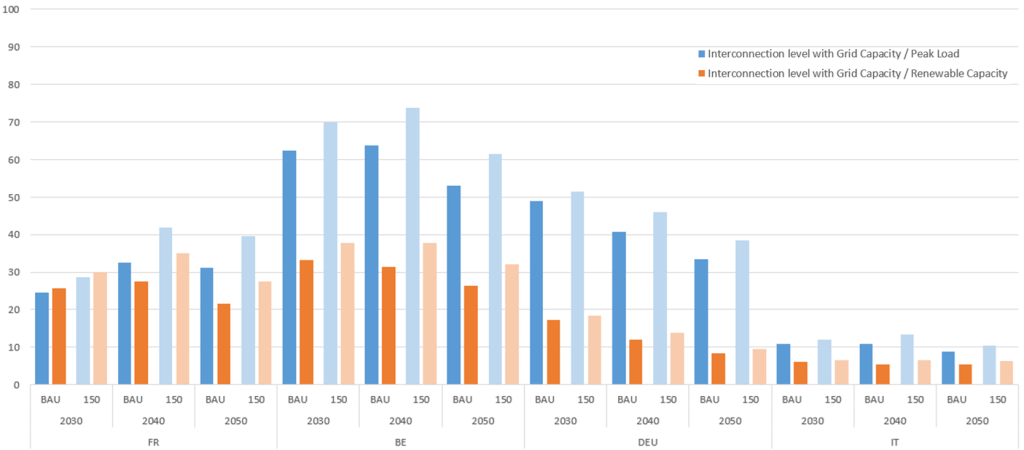
Furthermore, on the national level, the interconnection target can have an impact on the electricity generation mix. The increase in the electricity interconnection capacity can impact the energy composition share of some countries, especially for countries which are major electricity importers or exporters. Figure 14 shows the share of electricity production by technology for Finland and Netherland for the two scenarios of 2030 to 2050. For example, as more electricity grids are built for Finland and the Netherlands, there is an increase in the import/export activity for these two countries. The reason behind could be that on one hand, regarding Finland, due to the extra export requirement, higher capacity needs to be built, and wind energy is chosen as it is considered the most economical in the model. On the other hand, in the case of the Netherlands, the increased reliance on electricity imports contributes to a marginal decline in the domestic electricity generation capacity, particularly from gas turbines and photovoltaic (PV) systems.
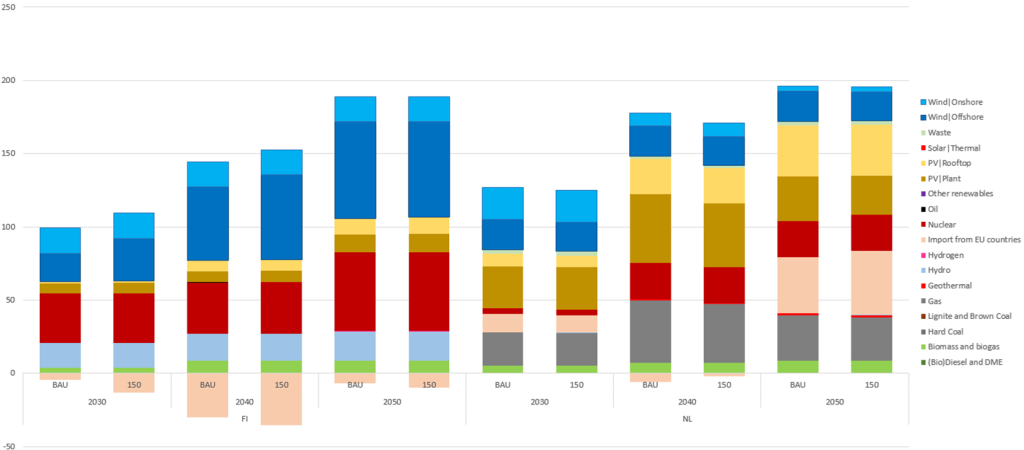
Figure 15 shows the greenhouse gas emission of France, Belgium, Germany and Italy from 2030 and 2050 for both scenarios compared to 1990. It can be observed that for both scenarios, the climate neutrality target is reached at 2050 and the 50% extra interconnection capacity barely has an impact on the decarbonization speed. Increased electricity interconnection capacity has barely any impact on the acceleration of the decarbonization process for countries like France, Belgium and Germany because the domestic electricity production in these countries, e.g. with nuclear power in France or renewable technologies in Germany, is much cheaper than the imported electricity price due to the CAPEX and fixed O&M from the electricity grids therefore the former is preferred. For other countries, in which the import price for electricity is lower than the cost of domestic production, the increased electricity interconnection capacity helps the decarbonization process.
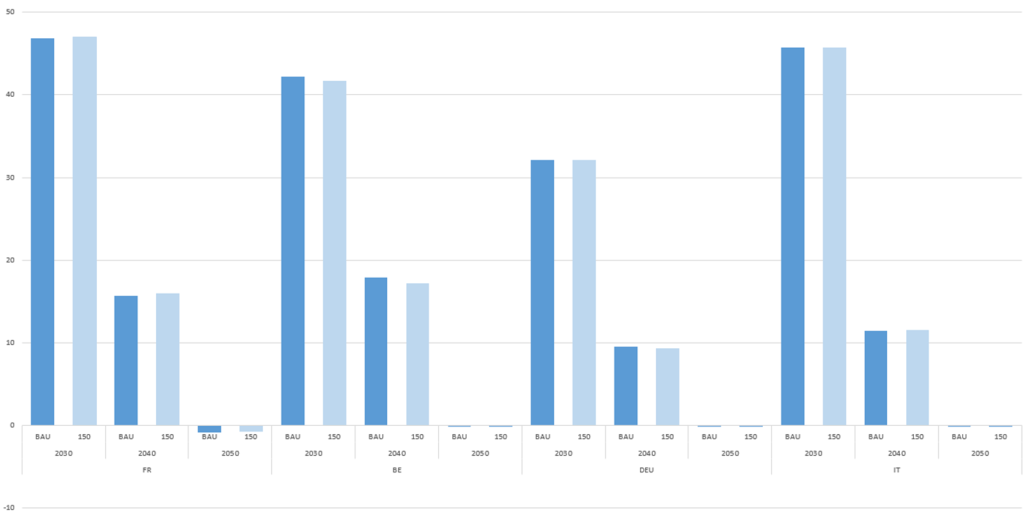
Policy implications: The EU 15 % interconnection target originates from a strong commitment by the EU Member States in the Council. If the EU 15 % interconnection target, and the national interconnection targets of the Member States, were seriously pursued, the potential rewards could be massive. However, this would require a timely implementation (into law) on both EU and national level, as the actual planning and building of energy infrastructures rely on long-term (investment) cycles. First of all, increasing the interconnection level will bring changes to the energy composition and energy system configuration of a country. For countries which are major importers, capacities for electricity production can be lowered, while for countries which are major exporters, capacities can be increased especially regarding renewable technologies. Furthermore, interconnections can enhance the resilience and security of the EU energy system by diversifying supply sources. Most importantly, they play a crucial role in helping the transition toward climate neutrality by 2050 at the EU level through the more efficient integration of renewable energy resources across member states, therefore requiring thorough consideration during the planning and implementation of cross-border energy infrastructures.
Key messages:
- The EU interconnection target could shape not only the future development of energy infrastructures but also the energy composition and system configuration of each country.
- A single interconnection target cannot address diverse Member State conditions and priorities although it is introduced alongside the electricity market.
- A flexible, resilient, and sustainable European energy infrastructure requires better harmonization of national and EU plans, efficient financing, and faster project execution; otherwise, investments in electricity and hydrogen infrastructures risk inefficiency.
References:
IEA (2022), World Energy Outlook 2022, IEA, Paris https://www.iea.org/reports/world-energy-outlook-2022, Licence: CC BY 4.0 (report); CC BY NC SA 4.0 (Annex A)
Sikow, Catharina & Vasilakos, Nicholas & Beato, Paulina & Virbickas, Daivis & Gence-Creux, Christophe & Lepy, Sébastien & Heidrecheid, Celine & Štritof, Ivona & Phulpin, Yannick & Bernard, Pierre & Mathiesen, Brian & Smyk, Michal & Mccormick, Terry & Battaglini, Antonella & Lont, Auke & Kreusel, Jochen & George, Cecile & Vidal-Quadras, Alejo. (2017). Towards a sustainable and integrated Europe – Report of the Commission Expert Group on electricity interconnection targets.
ENTSO-E, “TYNDP 2024: Europe’s electricity infrastructure plan.,” 2024. [Online]. Available: https://www.entsoe.eu/outlooks/tyndp/2024/#
ENTSOG, “TYNDP.” Accessed: Oct. 31, 2025. [Online]. Available: https://www.entsog.eu/tyndp
European Hydrogen Backbone, Implementation Roadmap – Part 1, 2023. [Online]. Available: https://www.ehb.eu/files/downloads/EHB-2023-Implementation-Roadmap-Part-1.pdf
4. Conclusions
The shifting economic and political landscape, characterized by geopolitical tensions and a heightened focus on strategic autonomy, demands that climate policy no longer functions in isolation but as an enabler of industrial and economic resilience. Our research demonstrates that an enabling condition to maintaining a robust industrial base amidst global trade barriers and an immense investment gap is a more sophisticated policy architecture. As such, the report’s findings speak to the energy transition as an essential vehicle for garnering competitiveness and securing long-term predictability for economic actors.
Effective climate governance under the competitiveness agenda
For the EU to stay on track on the path to climate neutrality under the Competitiveness Compass, the EU’s governance system needs reinforcements and refinements that can support investment certainty and facilitate the realisation of the transition. Our analysis points to challenges in the growing complexity of the target architecture (e.g. for 2040) while supporting the notion of targeted and performance-oriented simplification, including through an effective integration of climate and competitiveness processes and systems. Specific messages arising from the work in this area include:
- The EU’s specification of a 2040 climate target represents an important reaffirmation of the commitment to the path to climate neutrality – as cornerstone of the EU’s economic strategy of modernisation through the green transition. The new flexibilities included may have contributed to agreement on the ambition level of the target. However, they need careful consideration and proper design to ensure that they do not compromise this commitment, including in the eyes of investors.
- Simplification of the legal provisions guiding EU climate and energy policy may enhance competitiveness. Changes should be made with a view to enhancing Member States and companies’ ability to work within the respective framework and support the achievement of the EU’s targets. They should not lead to deregulation that undermines or even dissolves the steering function and direction needed for this purpose.
- The parallel pursuit of interconnected EU goals or different policy areas (and their respective administrative units) can lead to a fragmentation in policymaking and ultimately failure to reach the objectives. In line with the EU’s push for simplification of the regulatory framework, the respective governance systems for climate, competitiveness and social dimension should be integrated to ensure consistency. This could take the form of inter alia an expanded common core set of Key Performance Indicators relevant across all three areas as well as enhanced policy coordination at national and EU level, including EU support for Member States.
Successfully financing the energy transition
To sustain momentum towards climate neutrality amid shifting fiscal dynamics, the EU must address emerging imbalances in the dimensions energy transition, technology deployment, and social equity. Our analysis shows that households carry a disproportionate share of early transition costs as declining fossil fuel tax revenues widen the public financing gap, risking social acceptance. Strengthened public investment strategies and smarter use of government-owned organizations — whose governance structure and risk orientation critically shape technology diffusion — can accelerate the clean energy rollout while mitigating fiscal strain. At the same time, evolving disparities in the carbon intensity of household consumption call for an integrated policy mix that couples immediate compensation measures with long-term investment support to ensure a fair and inclusive transition across income groups. Key findings include:
- The energy transition can be conceptualized as an investment – an increase in costs today in exchange for lower energy expenditures in the decades to come. Our analysis highlights, that a growing gap emerges between the scale of necessary investment in the energy system and the decline in tax revenues from traditional energy sources. As shown by the NEWAGE model, households bear the financial burden of the transition well before benefiting from lower energy costs, which may lead to issues of social frictions and thus ultimately political acceptance.
- There are different shades of government-owned organizations: risk-seeking vs. risk-averse technology mandates, national vs. local governance levels, big vs. small organizations, low vs. high managerial autonomy, and debt vs. equity financial instruments. These differences matter for the extent to which government ownership can accelerate technology diffusion.
- Climate policy affects low- and high-income households differently. While the carbon intensity of consumption is falling in most countries, the decrease is more pronounced for high-income households in most EU countries in the last years. Climate policies should include short- and long-term measures to mitigate the unequal distribution of climate policy costs in the short run and the increase of the unequal distribution in the long run.
Embed EU’s industry transition into the realities of industrial policy and geopolitics
A successful industrial decarbonization strategy must balance climate ambition with economic efficiency and security. De-risking tools such as CCfDs can support the transition but must be designed with a clear understanding of the public cost of risk. Streamlining funding and state aid rules to tie support to GHG emissions intensity – and limiting the use of fossil-based low-carbon hydrogen – would focus scarce resources on the technologies with the greatest positive impact on the climate. At the same time, EU-wide carbon pricing may shift steel production toward regions with cheaper energy, suggesting that policymakers should avoid counterproductive interventions against emerging comparative advantages. National choices on green hydrogen supply and industrial demand will also shape regional investment patterns and energy prices under the EU ETS 1. Finally, the EU’s dependence on rare earths exposes clean technologies to supply shocks, highlighting the need for frameworks like the Clean Industrial Deal to link climate goals with raw-material security and sustained innovation.
- De-risking instruments like CCfDs impose a cost of risk on the public budget that is so far understudied. While these instruments will play an important role in the transition, their design needs to take the public cost of risk into account.
- The funding and state aid framework should be streamlined to couple funding and emission intensity. An exclusion or comprehensive limitation of the use of fossil-based LCH would furthermore ensure limited financial resources are used for technologies with the highest climate impact and strengthen the climate impact of the EU funding and financing framework.
- EU-wide carbon prices could drive future steel production away from traditional centers toward regions with lower energy costs. Even in the face of political resistance against structural change, policymakers should carefully consider any intervention against comparative disadvantages.
- National policies on the development of local (green) hydrogen production and the built-up of hydrogen demand in industry will have an impact on regional investment decisions and on energy prices in the transition of the EU energy system within the EU ETS.
- Clean technologies rely heavily on rare earths, making them vulnerable to supply shocks. The 2010 Chinese export restrictions revealed that the EU lagged behind Japan and South Korea in fostering substitute innovations, underlining the need for policy frameworks like the Clean Industrial Deal to link climate goals with raw material security and innovation support.
Designing an EU ETS for long-term credibility
The EU ETS drives clean-technology innovation and economy-wide knowledge spillovers, but increasing financial activity must be monitored to identify potential threats to market stability in the future. Upcoming reforms – especially of the Market Stability Reserve – could substantially shift the effective emissions cap and may outweigh changes to the linear reduction factor. However, any reform of the EU ETS Directive needs to have a solid legal basis; and the appropriate legislative procedures need to be followed. Measures primarily of a fiscal nature and those that significantly affect a Member State’s energy sovereignty may require unanimity voting in the Council under Art. 192(2) subpar. 1 TFEU. The Carbon Border Adjustment Mechanism helps prevent carbon leakage but has design gaps affecting competitiveness and global impact, and its effectiveness would improve with adjustments and international coordination. Overall, broader regional and global participation leads to better climate and economic outcomes than EU-only action. More detailed findings are:
- The EU ETS spurs clean-technology development in regulated firms and generates spillovers across the economy. It does so by encouraging collaborations that spread innovation beyond the boundaries of regulated sectors.
- Financial activity plays a substantial role in the EU ETS and should be carefully monitored to ensure it does not deplete the long-term liquidity required for effective hedging. Preliminary evidence suggests that funds may influence short-term price formation, but their role needs to be examined more closely.
- Adjustments to the Market Stability Reserve (MSR) intake threshold and intake rate discussed in the context of the upcoming EU ETS review can shift the effective emission cap between 2030 and 2050 substantially. The more potent the MSR the less effective are other interventions that aim at adjusting the supply of allowances such as a reduction of the linear reduction factor or the reintroduction of international credits.
- A(ny) proposed amendments to the EU ETS Directive should be examined as to whether they change the aim and content of the emissions trading system in a way that turns it into “provisions primarily of a fiscal nature” or measures that significantly affect a Member State’s energy sovereignty. Should that be the case, the special legislative procedure under Art. 192(2) subpar. 1 TFEU would need to be followed, requiring unanimity in the Council, while the European Parliament is only consulted.
- The EU Carbon Border Adjustment Mechanism (CBAM) is an important step to protect firms regulated in the EU ETS from carbon leakage, but its current design presents a complex picture. While it appears to shield EU producers from carbon leakage at home, it may also affect their competitiveness abroad and has loopholes that could reduce its global impact. Realizing the full potential of CBAM likely involves adjustments to support exporters and expand its scope, ideally in coordination with international partners.
- Carbon leakage protection instruments are key to protect regulated industries and can prevent the erosion of more ambitious European reduction efforts at a global level. The establishment of a climate club in combination with an overarching EU ETS and a common CBAM can be a favourable policy solution, especially if ambition levels outside the EU are low.
Developing a flexible, resilient, and sustainable energy infrastructure for 2030 and
beyond
Overall, the evolving EU framework, including the RED III and the 2030 interconnection target, underscores the need for coherent, forward-looking national reforms to ensure both legal certainty and effective system transformation. Germany’s current patchwork approach to transposing RED III reveals significant gaps that risk undermining the intended acceleration of renewable deployment, making comprehensive integration and the anchoring of multifunctionality in planning law essential. At the same time, the EU’s interconnection target represents a strategic commitment that will influence national infrastructure planning, energy mixes, and system configurations. Strengthening cross-border capacity and aligning domestic legislation with EU objectives will therefore be critical to unlocking the full potential of renewable energy expansion and achieving a resilient, integrated, and climate-neutral energy system. More detailed findings are:
- Right now, the German transposition of the new legal framework for planning and permitting procedures of the RED III is more of a patchwork added on the existing provisions than a full and coherent integration, implying a lot of legal uncertainties and considerable need for clarification. These have to be addressed by the national legislator for the reforms to have the desired acceleration effect. Afterwards, an extension of Renewable Acceleration Areas or infrastructure plans, for example for PhotovoltaicV or storage facilities, should be considered.
- To unlock the full potential of the RED III, multifunctionality – as required by Article 15b (3) RED III should be anchored as a guiding principle in Germany’s planning law. Amending section 7 (1) of the German Regional Planning Act and entailing a legal definition of multifunctionality within this provision is to be welcomed, but further reforms are needed to this law and, above all, to the BauGB (German Federal Building Code) in order to establish multifunctionality of land as a guiding principle of large-scale spatial planning in German law.
- The interconnection target of 15 % to 2030 constitutes a strong political commitment by the Member States to improve transnational electricity infrastructure.
- The European Commission is mandated– supported by the EU Member States – to achieve the EU’s interconnection target.
- The interconnection target is expected to shape not only the future development of energy infrastructures but also the energy composition and system configuration of each country.
- A single interconnection target cannot address diverse Member State conditions and priorities although it is introduced alongside the electricity market.
- A flexible, resilient, and sustainable European energy infrastructure requires better harmonization of national and EU plans, efficient financing, and faster project execution; otherwise, investments in electricity and hydrogen infrastructures risk inefficiency.
To conclude, the shift in the geopolitical and economic landscape has added significant complexity to the EU’s transition to climate neutrality. By refining the governance system, bridging the investment gap through smarter fiscal tools, and addressing sectoral challenges in industry and infrastructure, the EU can turn the transition to climate neutrality into a source of long-term economic resilience that serves as the foundation for a competitive and socially cohesive European economy.
Authors



Nikolas Messerschmidt
Universität Stuttgart – Institut für Energiewirtschaft und Rationelle Energieanwendung







Annika Gillich
Universität Stuttgart – Institut für Energiewirtschaft und Rationelle Energieanwendung













Dr. Ulrich Fahl
Universität Stuttgart - Institut für Energiewirtschaft und Rationelle Energieanwendung














Dimitrios Tsoutsoulopoulos
Universität Stuttgart – Institut für Energiewirtschaft und Rationelle Energieanwendung